Four-leaf clover
Amid all the media reports on how housing is still “in the tank,” one piece of news seemed to have escaped many of the pundits. Housing affordability could possibly reach an all-time high of near 200 in the second half of this year. That is, a household making the median income would have twice the income necessary to buy a median-priced home in America. To date, NAR’s housing affordability index reached an all-time high of 184 back in early 2009. It was only slightly above 100 during the housing bubble years, meaning that qualifying income barely met the requirements to buy a home even with a 20 percent down payment (if not using teaser-rate, funny/toxic mortgages). Historically over the past 40 years, the average affordability index was 118.
The principal reason for the expected record high housing affordability index reading is the rock bottom mortgage rates of 4.4 percent on a 30-year fixed rate. Add to that modest gains in the average wage rate, which rose 3 percent in 2009 and is up 1.2 percent this year-to-date in spite of the high unemployment rate. Consider now versus then when home prices were at their “bubble” peak in 2006.
shiny penny
Of course, like all things “real estate,” affordability is local as well. There will be considerable local market variations in affordability conditions. Remember that one of the main components of NAR’s affordability index is home prices. Some markets encountered only minimal price declines while others
such as Las Vegas experienced a 60 percent nose dive. Still, on a nationwide basis, the affordability conditions have risen to compelling levels.
However, if a sizable number of people view – rightly or wrongly – that home prices will fall further and raise the affordability levels to even higher levels, then homebuying will continue to remain soft. That will lead to a further build up of inventory and thus hold back a true price recovery. The price decline potential was evident in July’s housing data. Existing-home sales plunged 27 percent to 3.83 million seasonally adjusted annualized units – their lowest level since 1995. Even though there was little change in inventory (with 4 million homes available for sale), the actual months’ supply of inventory rose sharply to 12.5. The sales decline reflected the aftermath of taking the stimulus medicine away. For nearly all of June, homebuyers knew they had to close the deal by the end of June to qualify for the tax credit. Therefore – and naturally – people rushed in to close in June and not wait till July. Qualitative REALTOR® member survey data about recent homebuyers suggest that investors, all-cash buyers, and buyers of expensive homes stayed in the market in July, but first-time buyers did not.
rainbow
Going forward, home prices may fall, although I doubt in any meaningful way. Even if they do decline, there is no guarantee that affordability conditions will improve. Again, the principal reason for our current exceptionally high affordability conditions is lower mortgage rates. If prices were to fall 10 percent but mortgage rates creep up to 5.4 percent, then the affordability conditions could actually worsen.
As for home sales, there are far fewer people in the pipeline to buy a home in the immediate months after the tax credit expiration.
Consequently, expect continuing low sales at least through autumn. But sales should slowly come back because of the high expected affordability conditions. Winter months are generally slow ones for home sales. If sales this coming winter matches up with past “normal” winters, then it would be a good sign that the housing market is getting back on track to normal sales levels. If sales this winter remain 20 to 30 percent lower than normal, then we are looking at trouble with high inventory stuck at a double-digit months’ supply. Remember that the months-supply figure is also impacted by the raw count of homes listed for sale. Since inventory generally declines from summer to winter, the months’ supply will steadily fall, hopefully to 8 or 9 months, and close to the level consistent with continuing price stabilization. For example, inventory fell by 600,000 to 800,000 from July to December in each of the past 3 years. If a similar decline occurs this year and home sales slowly bounce back to 4.5 million (annualized sales) then we can have continuing price stabilization.
A compelling argument can be made about the best affordability conditions, but it will be for naught if consumers lack confidence. Confidence in turn will be directly impacted by the general direction of the economy. Unfortunately, the economic recovery is coming to a virtual halt. GDP growth rates in the past three successive quarters were: 5.0%, 3.7%, and 1.6%. The upcoming GDP growth rates could be even lower figures. (If it turns negative for two straight quarters, then another fresh recession is at hand). At such tepid growth rate the unemployment rate could well reach 10 percent. GDP growth in a post-recessionary environment should be 5 percent or better, not only to start growing but to compensate for the recessionary downfall.
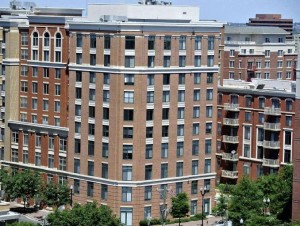
Entrance to the Jamieson Condominium
The weak economic expansion means that the job market will continue to look bleak and the unemployment rate could top 10 percent. This does not mean the country is necessary losing jobs on net right now. There have in fact been 763,000 private sector job creations from the beginning of the year to August. The soft economic expansion just means that the job creation pace is too slow to accommodate the rise in the labor force, particularly the recent high school and college graduates looking for work, aside from the need to fully re-hire the near 8 million job losses that occurred in the 2008 and 2009 recession. In a normal good year, there would be 2.5 to 3 million annual private sector job gains.
The homebuyer tax credit appears to have done its job in preventing home price over-correction. NAR prices show stabilizing pattern for the past 12 months while Case-Shiller price data show stabilizing patter for the past 18 months. We’ll still need to wait several more months to get a definitive gauge on price stabilization. At this point, we’ll see how the housing market behaves in the absence of the stimulus medicine. As with any sectors in the economy, it is very unhealthy to be dependent on government help for a long period. Compelling affordability conditions and some job creations are a move in the right direction and we have to just allow some time for these factors to work their way into the system. But an important question that will linger is of when consumer confidence will genuinely return to close on the deal.
by Lawrence Yun, NAR Chief Economist
HGTV’s real estate site Front Door says the weeks between now and the end-of-the year holidays are the best ones to find a bargain. Here are some of their tips for fall buyers and sellers:
Fall Sellers:
Replace faded summer plants with fall-blooming flowers and add autumn decorations to the home.
Expect low-ball offers and be prepared with higher counter offers.
Freshen up listing photos by shooting pictures that make it less obvious that the seasons have changed.
Price the home to sell. A price that is a little lower than the competition may be a winning move.
Be willing to show the property and hold open houses whenever potential buyers are ready.
Fall Buyers:
Look for motivated sellers who have a reason to move on by the end of the year.
Fall colors
Explore new constructions. Builders are often particularly interested in selling before the new tax year.
Beware of fall maintenance issues. Consider overflowing gutters and leaf-covered lawns warning signs.
Shape offers carefully. Even in this market it is possible to turn sellers off with a too-low bid.
Source: FrontDoor dot com (09/16/2010)photo credit: paul (dex)
Customer satisfaction improved for the third straight year and construction quality reached a record high in the J.D. Power and Associates 2010 U.S. New-Home builder Customer Satisfaction Study released Wednesday.
Here are the highest ranked builders in overall customer satisfaction in each of the 17 markets surveyed:
A survey by Fannie Mae shows that 70 percent of Americans believe it is a good time to buy a home.
That is up from 64 percent in January 2010.
Still, 33 percent–up from 30 percent in January–say they’ll rent next time around.
About 67 percent believe housing is a safe investment, down from 83 percent of people questioned in a similar survey in 2003.
Source: Reuters News (09/16/2010)For real estate in Arlington VA contact Nesbitt Realty
Federal style brick home on a shaded hillside
Interest in luxury real estate is picking up, according to a survey for United Marketing, which found that the percentage of people with incomes greater than $306,000 a year who plan to buy homes has risen from 3 percent in 2008 to 11 percent this year.
Laurie Moore-Moore, CEO of The Institute for Luxury Home Marketing, said that while she doesn’t believe this market is booming, she is seeing sellers who are more realistic about prices and that is persuading affluent buyers to consider purchases.
"Luxury home buyers have been buying this summer," said Moore-Moore. "After waiting in the wings, many affluent buyers spent the summer shopping for value and snapping up trophy properties."
Source: UPI, Steve Cook (09/12/2010)
State and local governments and nonprofit organizations will get a jump on investors as part of a new program announced Wednesday by the U.S. Department of Housing and Urban Development Secretary Shaun Donovan.
The National First Look Program is a partnership between lenders and communities to encourage neighborhood stabilization by giving public entities and community organizations the right of first refusal on properties that are likely candidates for renovation as affordable housing or targets for demolition to make way for new low-cost housing.
“This agreement helps us level the playing field to give communities a better chance to stabilize these neighborhoods,” Donovan says.
The First Look opportunity will last five to 12 business days. After that the financial institution will sell the home on the open market. Participating lenders represent 75 percent of the mortgage service companies, including Bank of America and Wells Fargo.
Source: U.S. Department of Housing and Urban Development (09/01/2010)photo credit: Vagabond Shutterbug
A study from Bankrate found that 90 percent of owners do not regret buying their home.
The findings also revealed improved mortgage awareness, with only 8 percent of home owners in the dark about what type of loan they have -- down from 26 percent two years ago.
The poll of 1,001 randomly selected home owners in August showed that 79 percent had fixed-rate financing, and this type of mortgage was used by almost 90 percent of respondents who make more than $75,000.
Source: Realty Times, Broderick Perkins (09/02/10)
Yields on U.S. commercial real estate are nearing a record high compared to Treasury bonds. Many investors take that as a signal to buy property.
Capitalization rates, a measure of real estate yields, averaged 7.22 percent in the second quarter, as calculated by the National Council of Real Estate Investment Fiduciaries. That was 4.29 percentage points higher than the yield on 10-year government bonds as of June 30 and 4.75 percentage points higher than Treasury yields as of Aug. 31.
These returns are near the record 5.39 percentage points in the first quarter of 2009, when the U.S. was dealing with the worst economic downturn since the Great Depression. The spread shrank to less than 80 basis points when commercial real estate prices peaked in 2007.
“The data indicate that real estate is poised for a rebound,” says Gerardo Lietz, who advises pension funds on property investments.
Source: Bloomberg, Hui-yong Yu (09/01/2010)
As large numbers of people age, an increasing percentage finds stairs a challenge.
Bucknell Manor stairway.
Housing safety experts say climbing stairs can be good exercise for older people, but the stairs should be safe. Among the things that need to be done to increase the safety factor are:
Add lighting at both the top and the bottom.
Put stair railings on both sides.
Make sure it is easy to see individual treads by adding visual contrast.
Consider an elevator or a lift.
Consider remodeling in order to live on one floor only.
Source: Washington Post, Maryann Haggerty (08/14/2010)
Yes, houses will sell as long as they are priced right. In many — but not all places — that means they’re priced low.
"People who price their homes to the market are selling them in a reasonable amount of time, but people who cling to 2004 or 2005 prices aren't," says Richard Smith, president and CEO of Realogy, the parent company of Century 21, ERA, Coldwell Banker and Sotheby's International Realty.
In some areas, pent-up demand has exploded. "It's crazy," says Brendon DeSimone, an associate with Paragon Real Estate in the Noe Valley near San Francisco. "I had one house with five offers, and it went from $1.4 million to $1.7 million. The valley has just popped. It's not uncommon for one open house to have 200 people come through."
Source: USA Today, Stephanie Armour (07/28/2010)
Home Prices In Arlington Continue To Hike
The housing market in Arlington County is getting more and more expensive as potential buyers continue to have fewer homes and condos to choose from.
Inlet Cove is alongside Route 1 This neighborhood of townhouses is near grocers and eateries Inlet Cove is close to Fort Belvoir, Alexandria, and Potomac Mills shops, in the city of Woodbridge Interior to these properties are multilevel Inlet Cove is serene
Pending home sales increased again in March, affirming that a surge of home sales is unfolding for the spring home buying season, according to the National Association of REALTORS®. The Pending Home Sales Index, a forward-looking indicator based on contracts signed in March, rose 5.3 percent to 102.9 from 97.7 in February, and is 21.1…
Some of the best housing deals are on high-end homes, many over $1 million. Some of them need TLC or they aren’t in the most-coveted locations. But there are plenty of desirable properties and lots of sellers who are getting impatient. Buyers with cash have the best opportunities. Buyers who need a mortgage should move…
The National Association of Realtors recently did a study about the characteristics of home buyers. Some of the findings might surprise you. Thirteen percent of buyers purchased a home with one or more parents and grandparents together with adult children. There were several reasons given for purchasing a multi-generational home. Cost savings; Children over the…





 Fall Sellers:

 That is up from 64 percent in January 2010.
Still, 33 percent–up from 30 percent in January–say they’ll rent next time around.
About 67 percent believe housing is a safe investment, down from 83 percent of people questioned in a similar survey in 2003.
Source: Reuters News (09/16/2010)
That is up from 64 percent in January 2010.
Still, 33 percent–up from 30 percent in January–say they’ll rent next time around.
About 67 percent believe housing is a safe investment, down from 83 percent of people questioned in a similar survey in 2003.
Source: Reuters News (09/16/2010)