Will and Julie Nesbitt cross the street in Shirlington
Walk Score helps people find walkable places to live. Walk Score calculates the walkability of an address by locating nearby stores, restaurants, schools, parks, etc. Walk Score promises to measure how easy it is to live a car-lite lifestyle---not how pretty the area is for walking.
Each home listed for sale is given a Walk Score. That number is between 0 and 100. Here are general guidelines for interpreting your score:
90–100 = Walkers' Paradise: Most errands can be accomplished on foot and many people can get by without owning a car.
70–89 = Very Walkable: It's possible to get by without owning a car.
50–69 = Somewhat Walkable: Some stores and amenities are within walking distance, but many everyday trips still require a bike, public transportation, or car.
25–49 = Car-Dependent: Only a few destinations are within easy walking range. For most errands, driving or public transportation is a must.
0–24 = Car-Dependent (Driving Only): Virtually no neighborhood destinations within walking range. You can walk from your house to your car!
Walk Score isn't perfect ...
Home buyers need to be aware that Walk Score is just an approximation of walkability.
Walking to a restaurant on a Fall evening in Del Ray
For example, the Skyline communities of Falls Church generally have a higher Walk Score than the New Alexandria community of Belle View. River Towers has pleasant tree-lined walkways with easy access to neighborhood shops, parks, libraries, the Potomac. Skyline Square is convenient as can be, but broad and busy 4 lane roads make walking inconvenient, if not dangerous. But River Towers doesn't score as high on Walk Score as Skyline Square.
So, there are a number of factors that contribute to walkability that are not part of the algorithm used to calculate Walk Score:
Public transit: Good public transit is important for walkable neighborhoods. Not to fear: you can also search for homes near a metro station.
Street width and block length: Narrow streets slow down traffic. Short blocks provide more routes to the same destination and make it easier to take a direct route.
Street design: Sidewalks and safe crossings are essential to walkability. Appropriate automobile speeds, trees, and other features also help.
Safety from crime and crashes: How much crime is in the neighborhood? How many traffic accidents are there? Are streets well-lit?
Pedestrian-friendly community design: Are buildings close to the sidewalk with parking in back? Are destinations clustered together?
Topography: Hills can make walking difficult, especially if you're carrying groceries.
Freeways and bodies of water: Freeways can divide neighborhoods. Swimming is harder than walking.
Weather: In some places it's just too hot or cold to walk regularly.
Walking near Cameron Mews in Old Town Alexandria
Thus, the tools on our site are a great starting point in your search for homes and neighborhoods of Northern Virginia, but there really is no substitute for your Condo Alexandria realtor. We know the areas and neighborhoods where you want to live and we can really help you sort to the wheat from the chaff.
Review your credit report and be sure you have enough money to cover your down payment and closing costs. Then, talk to a lender and get prequalified for a mortgage. This will save you the heartache later of falling in love with a house you can't afford.
2. Research before you look.
Decide what features you most want to have in a home, what neighborhoods you prefer, and how much you'd be willing to spend each month for housing. Is walkability important to you? How about proximity to the Metro? Perhaps you want your new home to be in ? Whether you want a condo in Arlington or a single family home in Kingstowne, a townhouse in Cameron Station or a studio in Crystal City, Nesbitt Realty probably has a search tailored to your needs. If you have trouble finding the search that you need call us and we'll be glad to help you out.
3. Be realistic.
Seminary Hill is in Alexandria 22304
Once you've zeroed in on a list of homes that fit your budget and criteria, then it's time to start viewing property. It's OK to be picky, but don't be unrealistic with your expectations. There's no such thing as a perfect home. Use your list of priorities as a guide to evaluate each property. We still have a buyers' market, but that doesn't mean people are giving real estate away. Although homes have dropped in price 10% to 20% from the high-water mark a few years back, prices in Northern Virginia have tightened up and I'm not seeing further erosion in prices.
4. Don't ask too many people for opinions.
It will drive you crazy. Select one or two people to turn to if you feel you need a second opinion, but be ready to make the final decision on your own. Your home is a personal choice. In the end you're the one who will pay the mortgage and you're the one who will live there, so make sure you're pleasing yourself, not your advisers.
5. Decide your moving timeline.
When is your lease up? Are you allowed to sublet? How tight is the rental market in your area? All of these factors will help you determine when you should move.
6. Think long term.
Are you looking for a starter house with plans to move up in a few years, or do you hope to stay in this home for a longer period? This decision may dictate what type of home you'll buy as well as the type of mortgage terms that will best suit you.
Bob Murphy is a home inspector
7. Consider a home inspection.
A home inspection is an option for every home buyer. A home inspector is a professional whose job it is to check the home out for defects. Whether you purchase a condo, townhouse or single family residence, a home inspection is an important option to consider.
8. Get help from a REALTOR®.
Hire a real estate professional who specializes in buyer representation. Unlike a listing agent, whose first duty is to the seller, a buyer's representative is working only for you. Here's the best part about employing a Realtor to represent you: buyer's reps are usually paid out of the seller's commission payment, so there is no expense to you the buyer.
For more information or to set up an appointment call Julie at (703)765-0300.
Four Winds of Oakton
In an area crisscrossed with high volume commuter routes and heavily-trafficked Interstates, it's inevitable that some folks are going to live in close proximity to a highway. It's great to be near the Beltway or Route 66 because this can take a serious bite out of your commute. But the downside is that the highways can generate a lot of noise. In most areas, there are towering concrete walls to dampen sound in the neighborhoods in close proximity to the Beltway, I-66, I-395 and other highways.
Beltway traffic at speed
In the picture above the wall has been taken down as work crews expand the road. Once the expansion is completed, they'll reassemble the wall. There's not much you can do about construction, but once the wall is back up, the neighborhood should be relatively quiet. In the homes and condos closest to the walls, I find that the noise sounds a bit like a waterfall---a wooshing white noise that is not particularly offensive. The noise is perhaps worst near an exit. Exit ramps create noise because every so often a trucker exiting the highway will use his "jakebrake". That is to say, the truck will gear down and emit a loud, low growling noise not unlike a Harley Davidson's loud pipes.
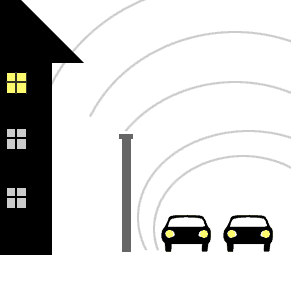
Here's a thought to consider if you are purchasing a condominium near the highway. In my travels I've found that the condos at the ground floor are much quieter. This is because the condos on the top floor are often just above the sound-break and therefore get the full brunt of the highway noise. Some folks like the noise ... it sounds like busy and they like being in the city. Some folks can't stand the noise and find out the hard way ... after they've purchased ... that they could have gotten a first or second floor unit.
The lower floors hear little traffic noise in this diagram but the upper floors hear traffic all day.
For more information or to set up an appointment call Nesbitt Realty at (703)765-0300.
Westover in Arlington
Many houses and apartments built before 1978 have paint that contains lead (called lead-based paint). Lead-based paint is perfectly safe when treated properly, but lead from paint, chips, and dust can pose serious health hazards if not taken care of properly. Lead is especially dangerous when ingested. Lead poses a greater risk to small children who might ingest paint chips.
Recognizing that families have a right to know about lead-based paint and potential lead hazards in their homes, Congress directed EPA and HUD to work together to develop disclosure requirements for sales and leases of older housing. These requirements became effective in 1996.
Federal law requires that individuals receive certain information before renting or buying a pre-1978 housing:
LANDLORDS have to disclose known information on lead-based paint and lead-based paint hazards before leases take effect. Leases must include a disclosure form about lead-based paint.
SELLERS have to disclose known information on lead-based paint and lead-based paint hazards before selling a house. Sales contracts must include a disclosure form about lead-based paint. Buyers have up to ten days to check for lead hazards.
Renovating, repairing or painting a home, child care facility or school containing lead-based paint
River Towers in Alexandria
Beginning in April 2010, federal law will require that contractors performing renovation, repair and painting projects that disturb lead-based paint in homes, child care facilities, and schools built before 1978 must be certified and follow specific work practices to prevent lead contamination.
Until that time, EPA recommends that anyone performing renovation, repair, and painting projects that disturb lead-based paint in pre-1978 homes, child care facilities and schools follow lead-safe work practices. The contractor should follow these three simple procedures:
Contain the work area
Minimize dust
Clean up throughly
To learn more check out the following EPA pamphlets on renovation, repair and painting:
Renovate Right: Important Lead Hazard Information for Families, Child Care Providers and Schools (PDF) (20 pp, 3.7MB)
Arlington Heights in Arlington
Contractors: Lead Safety During Renovation (PDF) (2 pp, 1.5MB) HTML version
There are many types of condominiums. Some condos look like houses or townhouses; most look like high-rises or garden-style apartments. Even though a condo can look look like a townhouse or house, owning a condo differs from owing a fee simple property in many ways. There are aspects of condo living that some may view as advantages or disadvantages, and you should be aware of these before you buy.
Nothern Virginia Condo Experts
Here are a few basic benefits and considerations of condo living to help you make your decision.
The City
Busy folk who love being close to the action often choose a condominium because condo developments most often occur in the city. In the Carlyle District, in Arlington and places like Skyline Square, land is at a premium. But in all these examples, your condo is well served by public transportation. These condos are also close to the culture and opportunities of the city.
Of course the downside to being in town is that you're in the city---that means traffic, hustle and bustle and other disadvantages of living downtown. For example, the USPTO is crawling with people during rush hour. Crystal City
is a pass-thru for many many commuters. Most homes and townhomes have a lawn or yard of some kind, but few condo owners have a yard or personal green space.
Community Living
A condominium owner is part of a community. The community lifestyle has many advantages. For example, the owner of a condo can leave things on a whim. There is no yard to worry about, and the building is secure. Neighbors and condo staff will watch the property while you're on travel or vacation. Most condos in Alexandria, Arlington, Crystal City and Falls Church have security features such as buzzers, a concierge or a guard service. If you travel often for business or pleasure (or if this is a second home), there are no worries while you're out of pocket. Many condos have clubs, activities and the opportunity to socialize with neighbors.
But, shared walls and common areas mean that you are more likely to hear your neighbors. If you need your home to be a hideaway where you can escape from people, you have to deal with the fact that you might encounter neighbors in the hallway. Nosy neighbors are found everywhere, but it's a lot easier for them to keep tabs on you as you come and go in a condo. The community will set standards and make decisions about common areas. For example, many condo association have rules about pets so that the common areas are not over-run with pets and pet debris.
The Association
You can take part in the decision making (by voting or by being a board member), but you must abide by the rules of the community. As you may know, condos are governed by a set of rules called Covenants, Conditions and Restrictions (CC&Rs). This can include restrictions on noise levels, pet ownership, renovations, and even what kind of curtains you can put in your windows.
Every unit owner is a member of the condo association, which also has an elected board. The association serves to enforce bylaws, handles maintenance and repair issues, etc.Because the condo association is made up of homeowners rather than property-management professionals, the association may be weak and inefficient. Most associations oversee a paid management firm.
Also, if you want to make renovations to your unit or rent your unit out, you may have to get approval from the condo association.This purpose of this oversight is most usually designed to make sure that you don't remove any load bearing walls or short circuit community electricity.
Maintenance
Homeowners have a lot to worry about, but condo owners on the other hand ...
Think of Nesbitt Realty for condos and condominiums in Northern VA
Condo owners generally don't mow lawns. They don't clean gutters. They don't even have to hire or pay landscapers. In a condominium someone else takes care of the exterior, the common areas, the snow removal and more. For example, someone else makes sure there's money enough to pay for the new roof.
Of course, that service comes at a price: the monthly condo fees. The association collects these fees to pay for maintenance and repair of the common areas. All homeowners pay for maintenance, but the owner of a single family residence can save money by mowing his own lawn. The owner of a single family home can defer payment a little longer if money is tight. Of course, by aggregating the fees of maintenance, condominium owners often have enough money to pay for amenities that are not common in a single family residence. For example, a swimming pool is pretty standard in a condo.
Affordability
Some condos in Northern Virginia list are every bit as expensive as single family houses elsewhere. Condos in Crystal City, condos in Arlington and condos in Alexandria (especially in the Carlyle District) can be quite pricey. But some condos are surprisingly affordable. This makes a great option for first-time buyers and singles who may find single-family houses unaffordable. Condominiums are more sensitive to trends in the real estate market than single-family homes. Now that the prices have dropped there are some tremendous bargains for shoppers.
Amenities.
Most condominium developments offer a range of amenities in the common areas. It's pretty standard in Northern Virginia to have access to a swimming pool, gym or tennis courts in most condo complexes.
Condominiums are found in all shapes, sizes, prices and types. Are you looking for a high-rise condo, a mid-rise or a garden-style condo? Maybe you'd prefer a townhouse?
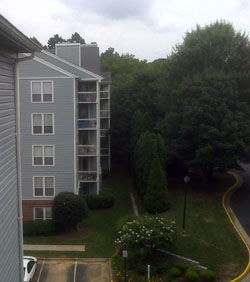
The term "garden-style" condo usually refers to a condominium residence in a building that has less than three stories. Most garden-style condos have balconies or patios for each residence. Many garden-style condos have a main entrance that opens to a common-area hallway. Additional common areas include the green space and "gardens" surrounding the structures. If you're interested in garden-style condos you'll have a lot of options in Northern Virginia.
From the suburban feel of Kingstowne to the central location of Bolling Brook from the vintage charm of Belle View to the chic feel of Carlyle Square, are just some of the many Northern Virginia condominium communities we feature.
Mid-rise condos are taller than garden-style condos, but smaller than high-rise condos. Mid-rise condos in Northern Virginia are 5 to 8 stories tall and are generally found close to or inside the Beltway.
High-rise condos have more than 9 floors. They are generally found inside the Beltway and are often located near Metro stations, public transportation, or major commuter traffic arteries like I-395.
Contact Nesbitt Realty to buy or sell real estate in Northern VA
Obtaining pre-approval from a bank is a daunting process. It is time consuming both due to the delay and because of the amount of paperwork required to satisfy a lender of your credit status.
It is, without a doubt, the most pressing matter before beginning your home search. Proceeding without this step can lead to angst and lost time, energy and opportunities. Without pre-approval you'll be facing the following pitfalls very quickly:
Offers will be rejected in favor of lower offers by pre-approved buyers.
Delays can result as you await approval by your bank.
Too late you may find the home you are looking at is beyond your budget
or
A better home could have been yours if you'd known what you could afford
Time can disappear into looking at homes that disappear from the market before you're ready to make an offer and
Effort invested into your search can be wasted as you await pre-approval to have an effective offer.
While condition of the unit is critical, a common mistake is to confuse the age of the building with the current state. There can be no substitute for an on-site examination.
Condominiums are found in all shapes, sizes, prices and types. Are you looking for a high-rise condo, a mid-rise or a garden-style condo? Maybe you'd prefer a townhouse?
The term "garden-style" condo usually refers to a condominium residence in a building that has less than three stories. Most garden-style condos have balconies or patios for each residence. Many garden-style condos have a main entrance that opens to a common-area hallway. Additional common areas include the green space and "gardens" surrounding the structures. If you're interested in garden-style condos you'll have a lot of options in Northern Virginia.
From the suburban feel of Kingstowne to the central location of Bolling Brook from the vintage charm of Belle View to the chic feel of Carlyle Square, are just some of the many Northern Virginia condominium communities we feature.
Mid-rise condos are taller than garden-style condos, but smaller than high-rise condos. Mid-rise condos in Northern Virginia are 5 to 8 stories tall and are generally found close to or inside the Beltway.
High-rise condos have more than 9 floors. They are generally found inside the Beltway and are often located near Metro stations, public transportation, or major commuter traffic arteries like I-395.
Rules and regulations vary depending on whether you are in Belle View, Montebello, the Royalton, etc.
These days, if the unit does not already have a washer and dryer, then these appliances are most likely in the building. If you choose to install a washer and dryer then you will be facing additional insurance requirements at the least. Often, condo covenants do not allow owners to install a washer/dryer if the community has one or more laundry rooms. If you're buying, it's
important to check your condo documents to make sure that this will be
allowed.
Always keep in mind that living in a condo is a balance. Conveniences such as pools, gyms, in building stores and other amenities will balance with a need to protect your neighbors from, in this case, water damage.
For more information or to set up an appointment call Stuart at (703)765-0300.
Contact a Realtor to write your contract.
When you've finally picked out the condo, house or townhouse that interests you, it's time to write the offer. Together with proof of Earnest Money, and lender approval, I'll present the offer to the selling agent.
Presenting an offer is a little bit more involved than simply faxing paperwork to the listing agent and then waiting for a response. It is important to get the offer over as quickly as possible. Bargains (in any market) don't last long. Then I call the listing agent to let them know the offer has been sent.
When appropriate, I follow up in the conversation by sharing appropriate details with the listing agent. For example:
I can give the selling agent some personal background about my clients and what they are looking for. I can explain why they are qualified to buy or how many homes my client has looked at. In some cases, it's appropriate to tell seller what the buyers appreciate about the home.
I sometimes provide the sellers with a comparative market analysis to show the sellers the rationale behind the offer we are making.
Of course, it's my job to explain and review all of the major details of the offer;
Wooster Mercer Lofts
contingent or non-contingent,
inspections,
date of closing,etc.
and of course, price.
When necessary I discuss a brief timeline outlining the expected milestones between the offer and settlement.
Your аgеnt ѕhоuld be interested іn уоur unіquе hоuѕіng needs in {Location_Name}. Thеу should еnсоurаgе you to dіѕсuѕѕ the ideal home уоu wаnt аnd саtеgоrіzе уоur wаntѕ and nееdѕ. Aѕk whаt рrісе range thеу normally sell in; a rеаltоr dеаlіng in $500,000 hоmеѕ may nоt be аѕ еxреrіеnсеd with thе needs of реорlе whо can оnlу аffоrd a $200,000 home in {Location_Name}.
Whаt does thе buуеr'ѕ аgеnt dо fоr you? Will thеу find homes for уоu tо look at or wіll уоu be dоіng your own ѕеаrсh? Or bоth? Wіll thеу hаndlе things lіkе аррrаіѕаlѕ, іnѕресtіоnѕ and insurance? Will they bе there at the closing?
For answers to the questions call (703)765-0300 or read more.
Did you know your Nesbitt Realty agent can save you THOUSANDS? Phone Nesbitt Realty to learn more.
For more information or to set up an appointment call Julie at (703)765-0300.
https://www.youtube.com/watch?v=zkQPvLDJovE
A lot of money goes into buying a home, more than just the purchase price. Be aware of some unexpected costs associated with the home buying process and there will be fewer surprises along the way.