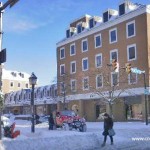
December snows in Old Town Alexandria shut the city down? No, Old Town is a walker’s paradise, and once the sidewalks were shoveled the town came to life.
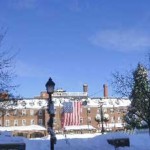
City Hall is shut down for snow. Market Square is roped off until the snow can be cleaned up.
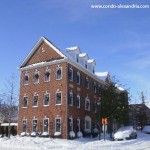
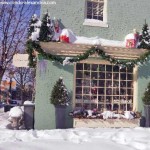
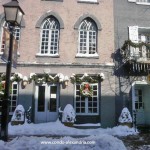
Old Town’s finer homes are tastefully dressed for the Winter.
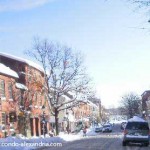
Here’s a historic look down King St. toward the Potomac. You’ll find no free trolley on the streets this day.
If you need a realtor who knows Alexandria, contact us at 703 765 0300.
Many of the restaurants and shops are ready for Christmas and upcoming holidays.
If you have a friend who is looking for easy metro access, a 3 bedroom home and only wants to spend about $300k to $350k it will be tough. But here are my best suggestions:
The Huntington Metro is also an option at with homes at Bucknell Manor and the Fort Hunt area. This is a traditional 1950’s neighborhood with lots of trees and good schools. Huntington Metro has 4500 parking spaces, so it’s a great metro to live close to because you can park and ride.
I also like parts of Franconia near Van Dorn but there is no parking at the Van Dorn Metro. Springfield and Burke are quite suburban but there is parking at the Franconia Springfield Metro.
I doubt you can find anything in Alexandria or Arlington that comes close to fitting in your budget. It’s possible to find home not far from the Vienna Metro. If you head further out towards Centreville and Oakton you can might find a home that suits you and you can drive to park at the Vienna Metro.
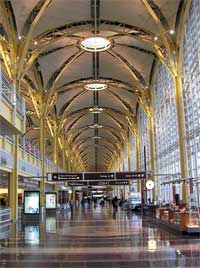
Main concourse of Reagan National AirportRonald Reagan Washington National Airport, formerly Washington National Airport, is on the Potomac River across from Washington DC. Along with Baltimore Washington International and Dulles International, Reagan National is one of three major airports serving the Washington Metro area. Reagan National is easily my favorite of the three airports for a number of reasons.
Dulles and BWI are massive sprawling airports with shuttle buses and mobile lounges. Reagan National barely has enough room for the runway. I always like smaller airports. They feel like they are scaled to human beings. There is plenty of security at National, but it seems to move along more smoothly than Dulles or BWI.
Dulles and BWI are outside the Beltway at the periphery of the Washington Capitol Area. Reagan National is at the heart of everything, wedged at the confluence of DC, Alexandria and Arlington. For me, it's a long drive just to get to BWI or Dulles, but Reagan National is here, and it's accessible by Metro. Reagan National is a station on both the Yellow and Blue lines.
Extended parking is available at Dulles or BWI, but on the shuttle bus, the ride from the parking lot to the terminal seems like a mile or more. At Reagan National, extended parking is at my house. Because instead of taking a shuttle, I can take the Metro to the airport. The runway is short at Reagan National, and it launches planes up over GW Parkway and at the Washington Monument, requiring a steep climb and a hard left on take off. Some folks find this terrifying, but I have to admit I love it. I know it's a safe path, because planes take off here day and night, so I sit back and enjoy the abrupt take-off and
turn.
Reagan National is open 24 hours a day 7 days a week, although many ticket counters and restaurants in the airport close during off-hours. Reagan National is located within the Commonwealth of Virginia, but it has a Washington DC address to identify the airport's location more easily for travelers.
The Perimeter Rule and the High Density Rule affect flights at Reagan National. Under the Perimeter Rule, nonstop aircraft flights are limited to a range of 1,250 miles or less. In 2000, Congress permitted the FAA to allow six round-trip flights to points outside the perimeter. The High Density Rule (or "Slot" rule) limits the number of landings or takeoffs allowed in an hour. The rule affects Reagan National because of the Airport's limited airfield capacity.
Reagan National is located in Arlington County near/in Crystal City. It is most easily accessed from the George Washington Parkway. There are a good many condos and homes in the Crystal City area and they're all just a metro stop away from Reagan National. The take-off and approach to Reagan National is down the Potomac, so that area residents get very little noise or fly-over from the jets at Reagan National.
The Arlington National Cemetery is recognized around the country and around the world, but nearby is a similar treasure from our nation's heritage: the Alexandria National Cemetery.
The Alexandria National Cemetery is located in the City of Alexandria VA
Arlington National Cemetery was featured in Gardens of Stone and numerous other feature films. This has no doubt added to Arlington's mystique and celebrity. Arlington Cemetery was carved from the farm of Robert E. Lee, a native of Alexandria. This is one of many connections between Arlington and Alexandria National Cemeteries.
The five acres of Alexandria National Cemetery are tiny compared to Arlington's 612 acres. Newcomers and those who don't know the history of the area may be surprised to learn that while Alexandria was a colonial era settlement, Arlington is a relatively new creation. (Check out Alexandria's best real estate deal ever!)
Alexandria National Cemetery predates the cemetery in Arlington and is in some ways the reason for Arlington's existence. Alexandria National Cemetery was established during the Civil War in 1862 as one of the original 14 national cemeteries.
The first four acres of Alexandria National Cemetery were purchased by the US government from what was to be Spring Garden Farm. By 1870, the United States purchased additional land to bring the cemetery up to its current size.
The first burials made in Alexandria National Cemetery were soldiers who died during training for the Civil War. Additionally, some casualties were sick or diseased soldiers from one of the numerous hospitals around Alexandria. The death and destruction wrought by the Civil War exceeded all expectations. It was evident that Alexandria National Cemetery would be woefully short of the needs imposed by the War. By 1864, Alexandria National Cemetery was nearly filled to capacity. In large part, the shortage of space in Alexandria led to the planning, development and construction of Arlington National Cemetery.
After the Civil War, improvements were made to the design of Alexandria National Cemetery and by 1871 the cemetery had added a fountain, a cobblestone avenue and graveled walkways. A wrought-iron rostrum, a small pond and a greenhouse were added as well. The primary building on grounds is a brownstone structure---the superintendent’s lodge. The lodge dating to 1870 is the oldest surviving building on the grounds. The lodge is constructed in a style and with materials popular from the era and perhaps best recognized in the the Smithsonian Institution's "Castle," and the U.S. Capitol floor and rotunda door frames.
Many of the graves at Alexandria National Cemetery date to the Civil War era
Like other national cemeteries, the Alexandria National Cemetery featured a "comfort station" built in 1887. This building is one of only a few such structures to survive to the present day. In 1927, the station significantly altered by adding a dining room and converting the facility into a kitchen/store room and tool-shed/toilet. The entire cemetery is surrounded by a wall of Seneca sandstone with River Blue Stone coping. (This is the same material used to build the superintendent's lodge.) Visitors gain entry by passing through a 12-foot wide ornamental cast-iron gate at the Wilkes Street entrance.
In the 1930's the flagpole was added and in 1995 the cemetery was added to the National Register of Historic places. There is no grave locator or kiosk on the grounds and the cemetery only has room for cremated remains and certain relatives of persons already buried at Alexandria National Cemetery.
Among other notable persons buried at the Alexandria National Cemetery are several "Buffalo Soldiers"---a nickname for several Cavalry Regiments of the US Army. Several African-American regiments of Buffalo Soldiers were formed during the Civil War to fight alongside the Union Army. Among these were the famed 54th Massachusetts Volunteer Infantry and many United States Colored Troops Regiments. After the Civil War, the Buffalo Soldiers were established by Congress as the first peacetime all-black regiments in the regular U.S. Army. It is fitting that these soldiers are buried near Alexandria's African American Heritage Park.
Together with the African American Heritage Park the Alexandria National Cemetery makes up the eastern boundary of the Carlyle District.







 allow six round-trip flights to points outside the perimeter. The High Density Rule (or "Slot" rule) limits the number of landings or takeoffs allowed in an hour. The rule affects Reagan National because of the Airport's limited airfield capacity.
Reagan National is located in Arlington County near/in Crystal City. It is most easily accessed from the George Washington Parkway. There are a good many condos and homes in the Crystal City area and they're all just a metro stop away from Reagan National. The take-off and approach to Reagan National is down the Potomac, so that area residents get very little noise or fly-over from the jets at Reagan National.
For more information or to set up an appointment call Stuart at (703)765-0300.
allow six round-trip flights to points outside the perimeter. The High Density Rule (or "Slot" rule) limits the number of landings or takeoffs allowed in an hour. The rule affects Reagan National because of the Airport's limited airfield capacity.
Reagan National is located in Arlington County near/in Crystal City. It is most easily accessed from the George Washington Parkway. There are a good many condos and homes in the Crystal City area and they're all just a metro stop away from Reagan National. The take-off and approach to Reagan National is down the Potomac, so that area residents get very little noise or fly-over from the jets at Reagan National.
For more information or to set up an appointment call Stuart at (703)765-0300.


