









By Nesbitt Realty – a family business



 Do you need a house for your ride? Use this search to find your perfect home with a garage.
 Are you seeking a water-view or waterfront home? Try our map search below.
 Looking for a bargain? You might find one in the foreclosures.
These neighborhoods have that special mixture of luxurious homes with a desirable location. Many of these neighborhoods are served by the area's best public schools.

There is a certain charm to a historic neighborhood that you cannot find elsewhere. Many of these neighborhoods date to the colonial era.

It's fun to live close to shops and restaurants.

Are you looking for a home or condo near a metro station? Use our site to find properties close to Metro stations.
 Condo shoppers might want to check out these resources:






 If you are selling real estate, you may want to "list" your property for sale with a real estate firm. If so, you will sign a "listing agreement" authorizing the firm and its agents to represent you in your dealings with buyers as your seller's agent. You may also be asked to allow agents from other firms to help find a buyer for your property.
For more information or to set up an appointment call Julie at (703)765-0300.
If you are selling real estate, you may want to "list" your property for sale with a real estate firm. If so, you will sign a "listing agreement" authorizing the firm and its agents to represent you in your dealings with buyers as your seller's agent. You may also be asked to allow agents from other firms to help find a buyer for your property.
For more information or to set up an appointment call Julie at (703)765-0300.
The term "garden-style" condo usually refers to a condominium residence in a building that has less than three stories. Most garden-style condos have balconies or patios for each residence. Many garden-style condos have a main entrance that opens to a common-area hallway. Additional common areas include the green space and "gardens" surrounding the structures. If you're interested in garden-style condos you'll have a lot of options in Northern Virginia.
From the suburban feel of Kingstowne to the central location of Bolling Brook from the vintage charm of Belle View to the chic feel of Carlyle Square, are just some of the many Northern Virginia condominium communities we feature.
Mid-rise condos are taller than garden-style condos, but smaller than high-rise condos. Mid-rise condos in Northern Virginia are 5 to 8 stories tall and are generally found close to or inside the Beltway.
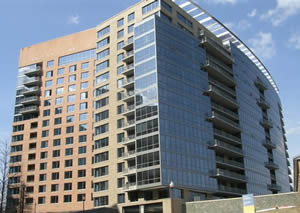
High-rise condos have more than 9 floors. They are generally found inside the Beltway and are often located near Metro stations, public transportation, or major commuter traffic arteries like I-395.

 When buying a condo or, realistically, almost any other large financial purchase, you can count on the fact that at least one (if not several) contracts will be involved in the process. However, many people may not know what a contract actually is.

 At its fundamental core, a contract is a legally binding agreement between two parties where a valid offer made by one party is accepted by the other, which is indicated by some mutual exchange of value. Under common contract law, this mutual exchange of value is called "consideration", which must be reasonably relied upon by both parties who agree to contract. Therefore, the three most fundamental elements of all legally valid contracts are offer, acceptance, and consideration.
 In addition, signing a written document is not necessarily an act of acceptance that therefore creates a contract. If the parties have already reached an agreement the written document and signatures may be introduced to the courts as parole evidence of an already existing agreement, but may not determine the validity of the contract on its own. If, for example, the court determines that the original offer was in fact rejected or, if there was a counteroffer which was accepted but without any new consideration, the written and signed contract may prove not to be a contract at all.
Alternatively, if there is nothing in writing or if parts of a written contract are missing, a court may hold that there was an implied contract that existed between the parties and in this instance, a list of the complete terms is not always required. In real estate transactions, for example, an incomplete description of a property may still validate the terms of the contract where the intent of the parties would be used to clarify the specific obligations or missing information that was otherwise implied. On the other hand, to be enforceable, a property sales contract must be written in some form (even if it is incomplete) and oral agreements to sell real estate are not legally binding. In real property contracts, the contract must identify the buyer, the seller and the property itself, even if some details are omitted. Lastly, a real estate contract must establish a purchase price and the terms of the sale in order to validate the agreement.
In addition, signing a written document is not necessarily an act of acceptance that therefore creates a contract. If the parties have already reached an agreement the written document and signatures may be introduced to the courts as parole evidence of an already existing agreement, but may not determine the validity of the contract on its own. If, for example, the court determines that the original offer was in fact rejected or, if there was a counteroffer which was accepted but without any new consideration, the written and signed contract may prove not to be a contract at all.
Alternatively, if there is nothing in writing or if parts of a written contract are missing, a court may hold that there was an implied contract that existed between the parties and in this instance, a list of the complete terms is not always required. In real estate transactions, for example, an incomplete description of a property may still validate the terms of the contract where the intent of the parties would be used to clarify the specific obligations or missing information that was otherwise implied. On the other hand, to be enforceable, a property sales contract must be written in some form (even if it is incomplete) and oral agreements to sell real estate are not legally binding. In real property contracts, the contract must identify the buyer, the seller and the property itself, even if some details are omitted. Lastly, a real estate contract must establish a purchase price and the terms of the sale in order to validate the agreement.
 Finally, a contract can be either unilateral or bilateral in nature. A unilateral contract is a promise for an act where acceptance of the offer is synonymous with the performance of the act and thus, a contract is only created when the act itself is done. Until then, the offeror reserves the right to withdraw the offer. For example, if I offer to pay you $20.00 to jump into the mud, you can either accept my offer by jumping into the mud and I would owe you $20.00 or, if I decide that I would rather keep the money, I can choose to withdrawal my offer so long as you have yet to jump in.
A bilateral contract, in contrast, is a promise for a promise where, as soon as promises are exchanged, both parties are instantly bound by each promise respectively. The vast majority of contracts are bilateral. Here, if I promise to give you $20.00 and you promise to jump into the mud, the contract is accepted by this exchange of promises and not by the performance of the promises themselves.
Finally, a contract can be either unilateral or bilateral in nature. A unilateral contract is a promise for an act where acceptance of the offer is synonymous with the performance of the act and thus, a contract is only created when the act itself is done. Until then, the offeror reserves the right to withdraw the offer. For example, if I offer to pay you $20.00 to jump into the mud, you can either accept my offer by jumping into the mud and I would owe you $20.00 or, if I decide that I would rather keep the money, I can choose to withdrawal my offer so long as you have yet to jump in.
A bilateral contract, in contrast, is a promise for a promise where, as soon as promises are exchanged, both parties are instantly bound by each promise respectively. The vast majority of contracts are bilateral. Here, if I promise to give you $20.00 and you promise to jump into the mud, the contract is accepted by this exchange of promises and not by the performance of the promises themselves.






All real estate licensees are not the same. Only real estate licensees who are members of the NATIONAL ASSOCIATION OF REALTORS(r) are properly called REALTORS(r). They proudly display the REALTOR "(r)" logo on the business card or other marketing and sales literature. All agents and brokers at Condo Alexandria are Realtors. REALTORS(r) are committed to treat all parties to a transaction honestly. REALTORS(r) subscribe to a strict code of ethics and are expected to maintain a higher level of knowledge of the process of buying and selling real estate. An independent survey reports that 84% of home buyers would use the same REALTOR(r) again.
Real estate transactions involve one of the biggest financial investments most people experience in their lifetime. Transactions today usually exceed $100,000. If you had a $100,000 income tax problem, would you attempt to deal with it without the help of a CPA? If you had a $100,000 legal question, would you deal with it without the help of an attorney? Considering the small upside cost and the large downside risk, it would be foolish to consider a deal in real estate without the professional assistance of a REALTOR(r).
But if you're still not convinced of the value of a REALTOR(r), here are a dozen more reasons to use a Realtor from Condo Alexandria.
For more information or to set up an appointment call Stuart at (703)765-0300.

