From time to time, sellers ask us how you can prepare for a home inspection.
Bob Murphy is a home inspector
Leave appliances clear: Don’t leave dirty dishes in the dishwasher or laundry in the washing machine or dryer. This is because the inspector will need to test the appliances, and he doesn’t want to have to pull out dirty clothes in front of everybody. The same is true for your oven and stovetop. The inspector will need to test them without moving your food or pots around.
Make things accessible: Ensure the location of the attic and crawlspace are identified and easy to access. Don’t make a home inspector move your belongings in order to gain access. Strategically placed bundles and belongings can imply that the seller is trying to hide something and can cause the buyer to get nervous and the home inspector to get very thorough.
Check the lightbulbs: If a lightbulb isn’t working, the inspector will need to determine if the fixture is inoperable. Save them time by making sure all the lightbulbs in the home operate, including those in the crawlspace, attic, and furnace rooms.
Note shut off valve: Sometimes the location of your water shut-off valve is not obvious. You may want to label this to make it more obvious.
The blizzard snow lasted about a week. It hit its climax on about day 3. Many roads built up with caked snow. In Bucknell Manor, nearby stores remained open during the inclement weather. Interested in buying, selling, renting, or property management of Real Estate in Northern Virginia? Call Nesbitt Realty today at (703) 765 0300.
Bucknell Manor in a blizzard in January
winter in Bucknell Manor
Bucknell Manor in winter snow with a poodle named Grover
Belle View Exxon gas station during snow
Bucknell Manor blizzard in January on Cavalier Drive
Grover my poodle in Bucknell Manor near Belle Haven during snow in winter
Bucknell Manor blizzard in January on Cavalier Drive
Bucknell Manor during a blizzard in January
Belle View Shopping Center during winter snow
Bucknell Manor in a blizzard
Bucknell Manor in winter with snow
Bucknell Manor in winter with snow
Bucknell Manor in winter with snow
Winter in Bucknell Manor on Cavalier Drive
Bucknell Manor snow in winter
Belle View Boulevard snowed
Bucknell Manor in winter with snow
Belle Haven in winter snow
Bucknell Manor blizzard in January on Cavalier Drive
Winter in Bucknell Manor on Cavalier Drive
Winter in Bucknell Manor on Cavalier Drive
Bucknell Manor on Cavalier Drive in winter after snow
Bucknell Manor in winter with snow
Bucknell Manor in winter with snow
Bucknell Manor in winter with snow
Bucknell Manor in winter snow
Belle Haven in the distance of Bucknell Manor in a blizzard
Bucknell Manor blizzard in January on Cavalier Drive
Bucknell Manor snow in winter
Bucknell Manor in winter with snow
Bucknell Manor on Cavalier Drive in winter after snow
Belle View Boulevard in winter snow
Bucknell Manor blizzard in January on Cavalier Drive
tipClean- The most obvious is cleaning. As much as you enjoy leaving your dirty laundry scattered everywhere and the dirty dishes piled up in the sink, cleaning is unavoidable. Hiring cleaners is often the best solution. Professional cleaners will scrub and clean the places you will easily overlook. The better your property shows, the easier it will sell.
Landscaping- The yard and the exterior of your home is the first thing potential buyers will see. Removing weeds, dead branches and making sure downspouts are functioning correctly are relatively inexpensive tasks that will do wonders on the first impression of your home. If you're thinking of moving next spring, (then) this winter, you should be working on your landscaping.
Paint- Painting your home in a neutral color that appears to a broad audience will help purchasers envision themselves in your home. Auburn red might look great to you, but it has the potential to turn off buyers.
De-clutter- It might be tough to let go of some items you have lying around your home. De-cluttering your home will give the impression of more space and give a more desirable impression.
Midtown Alexandria StationI received the following email from a landlord whose property we manage at Midtown Alexandria:
"We would like to consider listing the condo for sale at Midtown, maybe for 6 month periods. It would have to be an investor type due to the current tenant lease. The price I have in mind is $425k. On top of that would be your commission added. I know it is pricey in comparison to what exists but I would just like to get an idea of interest. Perhaps putting it on the market from time to time would be one strategy. Let me know your thoughts."
Here was my reply:
I honestly can't see how it would do you a bit of good and I'll tell you why.
But first I should let you know that I work with a number of investors who make purchases with me from time to time. I've been telling several of them that Midtown is a GREAT place to buy right now. I think it's a great place to buy for an investor because the prices at Midtown are way below what I think the actual value should be. There are a number of reasons compounding on each other to create the valuation problems of Midtown Alexandria Station:
- Many owners bought at the height of the market. Some of them bailed out through short-sales and foreclosures. Many are holding on for dear life and when they see the slightest possibility of escape they do so. Every bit of demand at Midtown is swamped by owners who would love to bail out.
- They've recently built a number of large apartment buildings in close proximity to Midtown. Many Midtown buyers are first-time buyers who are weighing the choice of renting vs. buying. As long as there is a glut of rental options, rents stay low. As long as rents stay low, there are a number of buyers who will prefer to rent rather than buy. Lower demand for buyers means lower prices for sellers.
- The rental competition mentioned above keeps rents low. Most investors look at cash flow when they invest. Appreciation is something they hope for, but they do not count on. When you look at the rent vs. the cost to purchase at Midtown the opportunity does not look appealing. There are a number of options that are nearby where the ROI is much higher than Midtown. A low ROI means a lot of risk. If there is no appreciation the investor has tied up a lot of money for no good reason.
The condos at Midtown Alexandria Station are located at the Huntington Metro Station.
That said, I have told a number of investors that I think now is an excellent time to buy at Midtown. The reason is because I think the pressures I listed above have compounded to the point that the price at Midtown is I think below the value at Midtown. I think an upward swing in value is about 2 years out. Here's why:
The National Science Foundation will be completed soon. The reason all those apartments were built is to take advantage of the increase in demand that will follow the NSF. Once the NSF is complete and the apartments start to fill up, I think the apartments will jack up their rents.
This will have a cascading effect on values at Midtown. When area rents go up, then the idea of purchasing at Midtown makes more sense for a first time home-buyer. When the rents go up then the property makes more sense for investors. These both increase demand.
At the same time there is a big redevelopment project slated for Huntington and as that phases that will have a huge impact on the perceived value of Midtown. Right now Midtown is a nice newer condo directly on the Metro, but in kind of okay but grungy neighborhood. In the future Midtown will be smack dab in the center of a new exciting neighborhood.
Midtown offers a convenient location and an outstanding value.
For this reason I think Midtown is going to see a lot of appreciation and I am encouraging investors to buy here. That said, the reason investors should buy here is the reason that selling is a bad idea for you. Let me start by saying investors want the absolutely cheapest available opportunity. If you are priced high, it doesn't matter what your view is or if you have renters, then there is NO chance an investor will take interest.
If you are priced low there is a chance that investor will take an interest, but the investor is only going to buy if he can talk you down from that low price. In other words, I don't think there is any chance that any investor would be interested in your property.
Home buyers who are buying a primary residence sometimes buy a higher priced unit. It is true that a homeowner will pay a few thousand more for the floors they like or the view they want or to be close to a particular amenity. But home buyers are only interested in properties that look great. They are turned-off by properties with renters. So, I think there is only a very small chance that any home buyer would have any interest in your property.
So all that is to help you explain my position when I tell you that I don't think you do yourself a bit of good by listing the property for sale right now and I think you actually hurt us a bit because we'd have to do work that I don't think would have even a hope of getting us any money. If this advice finds you in a mood where you still believe that listing the property for sale at $475k is a good thing to do at this time, then I would offer to list it for you for a flat fee.
Normally we would charge a 6% commission. Instead I would list it for you for 3% plus $500. This is a savings to you of about $14,000. 3% is payed to the selling agent (most likely another company) if/when the property sells. $500 is paid to us when we list the property, whether the property sells or not. We would still perform all the services we normally perform. That $500 would include the cost of professional photography (which is about $250) to list the property.
No, I don't think the property will sell. I understand why you want out and I empathize with your position. Although we cannot do anything to change the market I do think there is finally a light at the end of the tunnel.
It’s important to understand what legal responsibilities your real estate salesperson has to you and to other parties in the transaction. Ask what type of agency relationship your agent has with you:
Seller's representative (also known as a listing agent or seller's agent)
A seller's agent is hired by and represents the seller. All fiduciary duties are owed to the seller. The agency relationship usually is created by a listing contract.
Buyer's representative (also known as a buyer’s agent)
A buyer’s agent is hired by prospective buyers to represent them in a real estate transaction. The buyer's rep works in the buyer's best interest throughout the transaction and owes fiduciary duties to the buyer. The buyer can pay the licensee directly through a negotiated fee, or the buyer's rep may be paid by the seller or through a commission split with the seller’s agent.
Subagent
A subagent owes the same fiduciary duties to the agent's customer as the agent does. Subagency usually arises when a cooperating sales associate from another brokerage, who is not the buyer’s agent, shows property to a buyer. In such a case, the subagent works with the buyer as a customer but owes fiduciary duties to the listing broker and the seller. Although a subagent cannot assist the buyer in any way that would be detrimental to the seller, a buyer-customer can expect to be treated honestly by the subagent. It is important that subagents fully explain their duties to buyers.
Disclosed dual agent
Dual agency is a relationship in which the brokerage firm represents both the buyer and the seller in the same real
estate transaction. Dual agency relationships do not carry with them all of the traditional fiduciary duties to clients. Instead, dual agents owe limited fiduciary duties. Because of the potential for conflicts of interest in a dual-agency relationship, it's vital that all parties give their informed consent. In many states, this consent must be in writing. Disclosed dual agency, in which both the buyer and the seller are told that the agent is representing both of them, is legal in most states.
Designated agent (also called appointed agent)
This is a brokerage practice that allows the managing broker to designate which licensees in the brokerage will act as an agent of the seller and which will act as an agent of the buyer. Designated agency avoids the problem of creating a dual-agency relationship for licensees at the brokerage. The designated agents give their clients full representation, with all of the attendant fiduciary duties. The broker still has the responsibility of supervising both groups of licensees.
Nonagency relationship (called, among other things, a transaction broker or facilitator)
Some states permit a real estate licensee to have a type of nonagency relationship with a consumer. These relationships vary considerably from state to state, both as to the duties owed to the consumer and the name used to describe them. Very generally, the duties owed to the consumer in a nonagency relationship are less than the complete, traditional fiduciary duties of an agency relationship.
The National Association of Realtors writes, "Consumers want their real estate agent to be tech-savvy and offer lower fees than their competitors, finds a new survey by the real estate brokerage Redfin of nearly 1,000 recent home buyers and sellers." This is like a mission statement of Nesbitt Realty. Our agents are well-versed in the best real estate technology tools in the business and (unlike other brokers---including Redfin) Nesbitt Realty NEVER CHARGES ADMIN FEES!
Brothers working together at the office
NAR says, "About 62 percent of buyers and sellers said they are looking for lower fees in a real estate transaction. However, 22 percent of those surveyed said that low fees actually made them worry about the quality of the service." Admin fees are usually about $500 per transaction in Northern Virginia. These fees are often the life-blood of the large-chain brokerage. But what if you could get the same services as you would get from a national chain, but deal with a family-business? That's why our clients love Nesbitt Realty.
Buyers and sellers are also taking notice of what technology agents are using to help them on their house hunt or sale. Fifty-seven percent of buyers and sellers surveyed said the technology their real estate agent uses is important to them. On the other hand, 31 percent of consumers surveyed said “the only thing that matters is the quality of the agent.”
Nesbitt Realty uses the same Internet, the same MLS, the same advertising streams as the big brokerages. We use the same or better technology tools and we do it without charging our clients an admin fee.
It's also said that besides low fees and technology, the majority of buyers surveyed also indicated that they valued responsiveness in a real estate agent. In fact, it was the most sought-after trait for an agent among buyers. Forty-seven percent of buyers surveyed rated responsiveness as key — even over professionalism, local expertise, and experience.
Will Nesbitt
Our agents pick up the phone. We don't roll you over to voicemail. Not only can you talk to your Nesbitt Realty agent, you can always reach out the principal broker, father and founder of Nesbitt Realty, Will Nesbitt.
Sellers, on the other hand, rated responsiveness as the least important quality to them in a real estate agent. Instead, 44 percent of sellers said “experience selling homes like mine” was the most sought-after trait for them in a real estate agent. You might be surprised to learn that we agree with the respondents. That's why if Nesbitt Realty is not the best brokerage for your property, we'll be the first to tell you. We know what we are good at selling and we know when another agent would be a better fit.
We are a family-run business. You don't have to settle for a national chain.Source: “What Buyers, Sellers Want From Their Agent,” NAR Blog (March 23, 2015)
Nearly 10 percent of U.S. residents say they are so dissatisfied with their current housing, neighborhood, local safety, or public service to the point that they want to move, according to a newly released U.S. Census report, "Desire to Move and Residential Mobility: 2010-2011." But other factors are also making more Americans desire to switch their residences.
In its report, the Census recently highlighted several segments of the population who are showing some of the highest desires to move. Here are some of its findings:
1. Young householders: About 14.6 percent of Americans age 16 to 34 said they would like to move, compared to 10.3 percent of Americans age 35 to 54, and 6.3 percent age 55 and older.
2. Renters: 16.5 percent of all renters say they would like to move -- more than double the rate of home owners.
3. Those who live in impoverished areas: Home owners who lived in neighborhoods with a high poverty rate tended to show more desire to move.
4. Households with children: 14.3 percent of households with children said they wanted to move compared with 8.7 percent of households who did not have children.
5.Households with a disability: 12.5 percent of households with a disability said they wanted to move compared to 8.2 percent of those without a disability.
Source: U.S. Census Bureau
Many folks consider stairs and hallways as strictly utilitarian — a place to get somewhere else - but these spaces can be great for decorations.
Considering that stairs are often one of the first elements home buyers see when they enter the front door of a home for sale, beautifying the steps can be a smart investment.
Consider these ideas for making the stairway more attractive:
A few tastefully positioned flowers can really stand out on at a stairway
Paint a runner in a bold shade of marine paint. Or do it in a pattern, like a stripe or polka dot.
Carpet the stairs with a pattern that hides dirt – even if the rest of the house has hardwoods. (As an added plus, carpeted stairs are safer than bare, potentially slick ones.)
Tile the risers, the vertical part of the stairs that get scuffed easily.
The argument for staging a house to get it ready for sale is largely based on what are perceived as the shortcomings of vacant, or unstaged, properties. For one, advocates of the staging process say a vacant home distracts would-be buyers from focusing on the actual real estate.
River Towers Living Room
Instead, they allow themselves to speculate on the possible reasons the house is on the market — divorce, financial straits, and other scenarios — as well as on any defects the property may have. Small flaws, like nail holes and worn carpeting, are much more noticeable when the rest of the space is empty. Additionally, a vacant home allows dust to settle and stale odors to linger and spread, cutting short showing times and generating fewer sale chances.
All of these factors lead prospective buyers to submit low-ball bids on vacant homes. Other times, they will not even make a bid at all because empty dwellings simply do not allow them to make an emotional connection to the property. They may not even be able to visualize how their own furnishings may fit in a room, causing them to lose interest, say staging professionals.
Which rooms do you find more appealing?
Living room near the window
Montebello’s Living Spaces
living room at the Jamieson
Hardwood floors in a vacant unit don’t translate well in pictures and don’t make much of an impression in real life.
Carpet in a vacant bedroom doesn’t call to a buyer.
An empty dining area
Sunroom in a vacant unit
Living area with a contemporary feel at River Towers
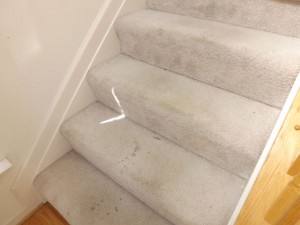
The carpet has some staining. I would recommend changing the floor on this level to a laminate or vinyl.
Ron Ginyard has the experience you need to successfully realize your real estate goals.
Short sales abound, but many real estate sales associates do not possess the time, training, or temperament to process this type of transaction. In particular, many sales associates would rather use the time that would be lost processing paperwork to instead pursue marketing, lead generation, and other more productive activities.
Rather than distract themselves from their core tasks, sales associates handling a short-sale listing can benefit from the involvement of a short-sale negotiator, but they must be careful to adhere to rules on agency relationships, insurance, and compensation.
Home owners may choose their own negotiator, although they often do not have the expertise to select the best professional; selling sales associates may retain a negotiator as part of their team, or this individual may be an independent contractor that they hire; or the buyer's sales associate may bring in the negotiator, although this may lead to agency issues since the buyer's sales associate then begins to represent the seller.
In any case, it is critical for listing and selling sales associates to be certain of their Errors & Omissions policies, which may or may not cover these activities. They also must take care to address how the negotiator will be paid — out of commissions that have been earned or as a separate or negotiated fee.
Second Liens Roadblock for Short Sales
Second mortgages have become one of the biggest roadblocks to closing short sales. There are about 450,000 properties in some stage of the foreclosure process with at least one junior lien, according to real estate research firm CoreLogic. These second liens are a primary challenge for Freddie Mac, said Mark Johnson, who oversees short sales…
The foreclosure mess is making it harder for banks to sell properties. ForeclosureRadar, which tracks foreclosures in five Western states, says the number of properties coming to auction in Arizona, California, and Nevada has declined by more than 30 percent. Investors are backing away from sales because they fear that the properties they buy will…
This real estate scheme usually happens when the borrower owes more on the property than the current value. The borrower then pretends they have a financial hardship and can not make any more payments. Someone, an accomplice, who is working with the borrower submits a low offer to buy the property. The lender agrees with the…