The City of Alexandria is proposing an affordable housing on the Douglas MacArthur Elementary School site. The city has announced that they would not only be exploring co location options but also providing funding to Alexandria City Public Schools for potential housing options. This announcement came as a surprise to many council members. Continue reading
Other than building large, custom houses, local homebuilder, Classic Cottages will now also be providing high-end "backyard cottages".
Interior of URBANEER 510 Accessory Dwelling Unit (courtesy photo)Continue reading
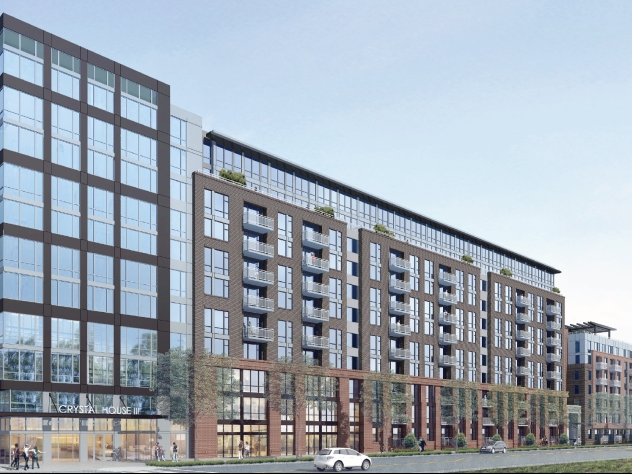
The Couty board has voted to add 819 new housing units, two public parks and a small amount of ground-floor retail space to their 17-acre site in Crystal City.
Approved Crystal Houses Development planContinue reading
Amazon has offered to contribute $20 million to the Arlington County Affordable Housing Investment Fund in exchange for being allowed to build two 22-story office buildings with a total of 2.15 million square feet of office and retail space in the county.
To get Arlington Real Estate services, contact Nesbitt Realty.Continue reading
The Virginia Square affordable housing project focussing on veterans will receive a combined loan of $13,700,000 from the Commonwealth of Virginia and Arlington County.
The planned redevelopment of American Legion Post(image courtesy of Arlington County)Continue reading
The owner of a hotel in Arlington is hoping to turn it into a residential building.
According to a recent article by wtop.com, the owner filed plans with the county hoping to change the Arlington Court Suites Hotel in Courthouse to a 180-unit apartment building called, Park Arlington at Courthouse.
Court House Metro stops near the Arlington County Courthouse.Continue reading
The National Climate Assessment report on the impacts of climate change on the United States outlined the effects of climate change, such as heat waves, flooding, drought, and more frequent extreme weather.
In 2013, Arlington adopted a transformative Community Energy Plan which aimed to reduce Arlington's greenhouse gas emissions by 75 percent by 2050. This came as Virginia continues to feel the impact of rising sea-level.
With buildings contributing to 39 percent of carbon dioxide emission in the United States, Arlington has to come up with creative ways to solve its shortage of affordable homes and still keep up with its 2050 vision. According to an article at Greater Greener Washington the shortage of affordable homes has become even more pressing given Amazon’s decision to move one of its new headquarters to Arlington.Continue reading
In November 2018, Amazon announced that it had selected Arlington County from more than 230 jurisdictions in America as their new headquarters, commonly known as HQ2. This announcement capped a 14-month process that had galvanized Northern Virginia localities to form a multi-jurisdictional partnership in their bid for the headquarters.
An article by Northern Virginia Realtors recently reported that Arlington County Board has unanimously approved the County's proposed direct financial incentive to Amazon. This is an annual pay-for-performance grant that is valued at approximately $23 million tied to the company's meeting target of occupying at least six million square feet of office space over the next 15 years.
Arlington County Board chair, Christian Dorsey, said that this performance agreement will be a long and productive partnership between Arlington and Amazon. "I view this agreement as a new model of economic development, where most resources are devoted to improvement in infrastructure and developing human capital," he said.
Arlington County also committed to using the portion of the new increment revenue generated by the arrival of Amazon within the existing Crystal City, Potomac Yard, Pentagon City Tax Increment Financing (TIF) area to make strategic infrastructure investments in and around National Landing. The TIF revenue is estimated to be around $28 million over 10 years.
3 New Investment Opportunities for Arlington
Technology- As part of its incentive package, the Commonwealth of Virginia proposed over $1 billion for a Tech Talent Investment Fund. This fund will produce 25,000 additional bachelors and masters degrees in computer and science-related fields throughout Virginia. The Commonwealth will also provide new resources related to computer science education statewide that will be accessible to the Arlington and Alexandria public schools. These resources will include professional development for current and future teachers, high-quality curriculum-related resources, summer and after-school programming for students, and meaningful career exposure and work-based learning opportunities in high-demand fields.
Transportation- The Commonwealth will invest up to $195 million of non-general fund money in new or expanded transportation projects to improve mobility in the region. The planned investment will include New entrance to the Crystal City Metro Station; Improvements to U.S. Route 1 in Arlington County; Pedestrian bridge from Crystal City to Reagan National Airport and a Transitway expansion supporting Pentagon City, Crystal City, and Potomac Yard in both Alexandria and Arlington.
Affordable Housing- With the new revenues generated by Amazon, Arlington and Alexandria will be able to fund affordable housing, workforce housing, and public infrastructure. Together, the two communities plan to invest at least $150 million over the next decade in affordable housing. This will result in the creation and preservation of 2,000 to 2,400 affordable and workforce units in and around the Crystal City, Pentagon City, and Columbia Pike areas and throughout Alexandria.
Brick sidewalks are common in the 22314 zipcode
Moves across county and state lines are falling, with the 2007-2009 recession blamed for changing Americans’ moving patterns, according to an analysis of census data through 2010. The Great Recession caused more Americans to move because they could no longer afford to remain where they were. That's a big change in what traditionally motivates Americans to move -- a bigger home or higher paying job, USA Today reports about the analysis.
Nine percent of Americans stayed local with their moves during 2007-2009 period -- the highest in a decade.
"Typically, over the last couple of decades, when Americans moved, they moved to improve their lives," says Michael Stoll, author of the research and chairman of UCLA's public policy department. "This is the shock: For the first time, Americans are moving for downward economic mobility. Either they lost their house or can't afford where they're renting currently or needed to save money.”
More than 23 percent moved for more affordable housing during the recession. Prior to the recession, that percentage stood at 20.8 percent.
Also, prior to the recession, 41.3 percent of Americans moved in order to own a home or settle into a better neighborhood. However, during the recession, that percentage dropped to 30.4 percent.
Source: “Americans on the Move Start Moving Down, Not Up; Setback in Upward Mobility Hits Blacks, Sun Belt Spots Hardest,” USA Today (Feb. 20, 2013)
Home Prices In Arlington Continue To Hike
The housing market in Arlington County is getting more and more expensive as potential buyers continue to have fewer homes and condos to choose from.
Inlet Cove is alongside Route 1 This neighborhood of townhouses is near grocers and eateries Inlet Cove is close to Fort Belvoir, Alexandria, and Potomac Mills shops, in the city of Woodbridge Interior to these properties are multilevel Inlet Cove is serene
Pending home sales increased again in March, affirming that a surge of home sales is unfolding for the spring home buying season, according to the National Association of REALTORS®. The Pending Home Sales Index, a forward-looking indicator based on contracts signed in March, rose 5.3 percent to 102.9 from 97.7 in February, and is 21.1…
Some of the best housing deals are on high-end homes, many over $1 million. Some of them need TLC or they aren’t in the most-coveted locations. But there are plenty of desirable properties and lots of sellers who are getting impatient. Buyers with cash have the best opportunities. Buyers who need a mortgage should move…
The National Association of Realtors recently did a study about the characteristics of home buyers. Some of the findings might surprise you. Thirteen percent of buyers purchased a home with one or more parents and grandparents together with adult children. There were several reasons given for purchasing a multi-generational home. Cost savings; Children over the…
Four-leaf clover
Amid all the media reports on how housing is still “in the tank,” one piece of news seemed to have escaped many of the pundits. Housing affordability could possibly reach an all-time high of near 200 in the second half of this year. That is, a household making the median income would have twice the income necessary to buy a median-priced home in America. To date, NAR’s housing affordability index reached an all-time high of 184 back in early 2009. It was only slightly above 100 during the housing bubble years, meaning that qualifying income barely met the requirements to buy a home even with a 20 percent down payment (if not using teaser-rate, funny/toxic mortgages). Historically over the past 40 years, the average affordability index was 118.
The principal reason for the expected record high housing affordability index reading is the rock bottom mortgage rates of 4.4 percent on a 30-year fixed rate. Add to that modest gains in the average wage rate, which rose 3 percent in 2009 and is up 1.2 percent this year-to-date in spite of the high unemployment rate. Consider now versus then when home prices were at their “bubble” peak in 2006.
shiny penny
Of course, like all things “real estate,” affordability is local as well. There will be considerable local market variations in affordability conditions. Remember that one of the main components of NAR’s affordability index is home prices. Some markets encountered only minimal price declines while others
such as Las Vegas experienced a 60 percent nose dive. Still, on a nationwide basis, the affordability conditions have risen to compelling levels.
However, if a sizable number of people view – rightly or wrongly – that home prices will fall further and raise the affordability levels to even higher levels, then homebuying will continue to remain soft. That will lead to a further build up of inventory and thus hold back a true price recovery. The price decline potential was evident in July’s housing data. Existing-home sales plunged 27 percent to 3.83 million seasonally adjusted annualized units – their lowest level since 1995. Even though there was little change in inventory (with 4 million homes available for sale), the actual months’ supply of inventory rose sharply to 12.5. The sales decline reflected the aftermath of taking the stimulus medicine away. For nearly all of June, homebuyers knew they had to close the deal by the end of June to qualify for the tax credit. Therefore – and naturally – people rushed in to close in June and not wait till July. Qualitative REALTOR® member survey data about recent homebuyers suggest that investors, all-cash buyers, and buyers of expensive homes stayed in the market in July, but first-time buyers did not.
rainbow
Going forward, home prices may fall, although I doubt in any meaningful way. Even if they do decline, there is no guarantee that affordability conditions will improve. Again, the principal reason for our current exceptionally high affordability conditions is lower mortgage rates. If prices were to fall 10 percent but mortgage rates creep up to 5.4 percent, then the affordability conditions could actually worsen.
As for home sales, there are far fewer people in the pipeline to buy a home in the immediate months after the tax credit expiration.
Consequently, expect continuing low sales at least through autumn. But sales should slowly come back because of the high expected affordability conditions. Winter months are generally slow ones for home sales. If sales this coming winter matches up with past “normal” winters, then it would be a good sign that the housing market is getting back on track to normal sales levels. If sales this winter remain 20 to 30 percent lower than normal, then we are looking at trouble with high inventory stuck at a double-digit months’ supply. Remember that the months-supply figure is also impacted by the raw count of homes listed for sale. Since inventory generally declines from summer to winter, the months’ supply will steadily fall, hopefully to 8 or 9 months, and close to the level consistent with continuing price stabilization. For example, inventory fell by 600,000 to 800,000 from July to December in each of the past 3 years. If a similar decline occurs this year and home sales slowly bounce back to 4.5 million (annualized sales) then we can have continuing price stabilization.
A compelling argument can be made about the best affordability conditions, but it will be for naught if consumers lack confidence. Confidence in turn will be directly impacted by the general direction of the economy. Unfortunately, the economic recovery is coming to a virtual halt. GDP growth rates in the past three successive quarters were: 5.0%, 3.7%, and 1.6%. The upcoming GDP growth rates could be even lower figures. (If it turns negative for two straight quarters, then another fresh recession is at hand). At such tepid growth rate the unemployment rate could well reach 10 percent. GDP growth in a post-recessionary environment should be 5 percent or better, not only to start growing but to compensate for the recessionary downfall.
Entrance to the Jamieson Condominium
The weak economic expansion means that the job market will continue to look bleak and the unemployment rate could top 10 percent. This does not mean the country is necessary losing jobs on net right now. There have in fact been 763,000 private sector job creations from the beginning of the year to August. The soft economic expansion just means that the job creation pace is too slow to accommodate the rise in the labor force, particularly the recent high school and college graduates looking for work, aside from the need to fully re-hire the near 8 million job losses that occurred in the 2008 and 2009 recession. In a normal good year, there would be 2.5 to 3 million annual private sector job gains.
The homebuyer tax credit appears to have done its job in preventing home price over-correction. NAR prices show stabilizing pattern for the past 12 months while Case-Shiller price data show stabilizing patter for the past 18 months. We’ll still need to wait several more months to get a definitive gauge on price stabilization. At this point, we’ll see how the housing market behaves in the absence of the stimulus medicine. As with any sectors in the economy, it is very unhealthy to be dependent on government help for a long period. Compelling affordability conditions and some job creations are a move in the right direction and we have to just allow some time for these factors to work their way into the system. But an important question that will linger is of when consumer confidence will genuinely return to close on the deal.
by Lawrence Yun, NAR Chief Economist