Gadsby’s Tavern in Old Town Alexandria

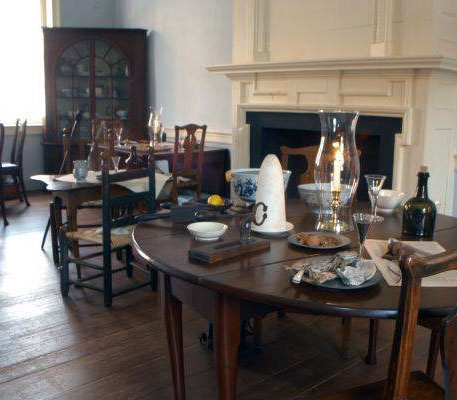
Old Town Alexandria is famed for its quaint historical atmosphere. Englishman John Gadsby operated a tavern here from 1796 to 1808. In those days, the tavern was the hub of political, business and social circles in Alexandria. Thus, Gadsby's Tavern is an important part of the 18th Century heritage of today's Old Town Alexandria.
tavern
Gadsby's has been a landmark in Alexandria since colonial days.
Today Gadsby's Tavern Museum is located on Royal Street, a few blocks from route of the King St. trolley. Admission is only $4 for adults and $2 for children. Children under 11 are FREE when accompanied by a paying adult. The museum consists of two buildings, a ca. 1785 tavern and the 1792 City Hotel. While in operation, the tavern was the setting for dancing assemblies, theatrical and musical performances, and meetings of local organizations. Prominent patrons such as George Washington, John Adams, Thomas Jefferson, James Madison, and the Marquis de Lafayette are part of the history of Gadsby's. At the tavern you can journey back to the 18th-century in a place where famous historical figures and everyday people dined and slept. The museum helps educate today's generations about the history, architecture, decorative arts, social customs, food, and clothing of the 1700's. There is a restaurant still in operation in the building. The tavern can be rented for weddings, banquets and any meeting where linen tablecloths and a post-colonial setting are appreciated. Please note some tour times are not available due to special events at the museum.  Please call in advance or check the online calendar for more information.

Alexandria National Cemetery

  The Arlington National Cemetery is recognized around the country and around the world, but nearby is a similar treasure from our nation's heritage: the Alexandria National Cemetery.
flag at Alexandria National Cemetery
The Alexandria National Cemetery is located in the City of Alexandria VA
Arlington National Cemetery was featured in Gardens of Stone and numerous other feature films. This has no doubt added to Arlington's mystique and celebrity. Arlington Cemetery was carved from the farm of Robert E. Lee, a native of Alexandria. This is one of many connections between Arlington and Alexandria National Cemeteries. The five acres of Alexandria National Cemetery are tiny compared to Arlington's 612 acres. Newcomers and those who don't know the history of the area may be surprised to learn that while Alexandria was a colonial era settlement, Arlington is a relatively new creation. (Check out Alexandria's best real estate deal ever!) Alexandria National Cemetery predates the cemetery in Arlington and is in some ways the reason for Arlington's existence. Alexandria National Cemetery was established during the Civil War in 1862 as one of the original 14 national cemeteries. The first four acres of Alexandria National Cemetery were purchased by the US government from what was to be Spring Garden Farm.  By 1870, the United States purchased additional land to bring the cemetery up to its current size. The first burials made in Alexandria National Cemetery were soldiers who died during training for the Civil War. Additionally, some casualties were sick or diseased soldiers from one of the numerous hospitals around Alexandria. The death and destruction wrought by the Civil War exceeded all expectations. It was evident that Alexandria National Cemetery would be woefully short of the needs imposed by the War. By 1864, Alexandria National Cemetery was nearly filled to capacity. In large part, the shortage of space in Alexandria led to the planning, development and construction of Arlington National Cemetery. After the Civil War, improvements were made to the design of Alexandria National Cemetery and by 1871 the cemetery had added a fountain, a cobblestone avenue and graveled walkways. A wrought-iron rostrum, a small pond and a greenhouse were added as well. The primary building on grounds is a brownstone structure---the superintendent’s lodge.  The lodge dating to 1870 is the oldest surviving building on the grounds. The lodge is constructed in a style and with materials popular from the era and perhaps best recognized in the the Smithsonian Institution's "Castle," and the U.S. Capitol floor and rotunda door frames.
Alexandria National Cemetery
Many of the graves at Alexandria National Cemetery date to the Civil War era
Like other national cemeteries, the Alexandria National Cemetery featured a "comfort station" built in 1887. This building is one of only a few such structures to survive to the present day. In 1927, the station significantly altered by adding a dining room and converting the facility into a kitchen/store room and tool-shed/toilet. The entire cemetery is surrounded by a wall of Seneca sandstone with River Blue Stone coping. (This is the same material used to build the superintendent's lodge.) Visitors gain entry by passing through a 12-foot wide ornamental cast-iron gate at the Wilkes Street entrance. In the 1930's the flagpole was added and in 1995 the cemetery was added to the National Register of Historic places. There is no grave locator or kiosk on the grounds and the cemetery only has room for cremated remains and certain relatives of persons already buried at Alexandria National Cemetery. Among other notable persons buried at the Alexandria National Cemetery are several "Buffalo Soldiers"---a nickname for several Cavalry Regiments of the US Army. Several African-American regiments of Buffalo Soldiers were formed during the Civil War to fight alongside the Union Army. Among these were the famed 54th Massachusetts Volunteer Infantry and many United States Colored Troops Regiments.  After the Civil War, the Buffalo Soldiers were established by Congress as the first peacetime all-black regiments in the regular U.S. Army. It is fitting that these soldiers are buried near Alexandria's African American Heritage Park. Together with the African American Heritage Park the Alexandria National Cemetery makes up the eastern boundary of the Carlyle District.  

The Potomac River

Washington Monument
Creative Commons License photo credit: CrimsonMage
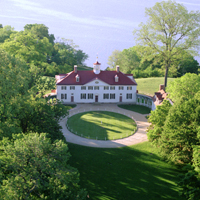
The Potomac River is located on the east coast of the United States, and runs through Maryland, Virginia, West Virginia, and Washington, D.C. before it empties into the Chesapeake Bay. It is over 380 miles long and wider than 11 miles at its widest point. As it passes through Washington DC, the nation's capital, the Potomac passes the Washington Monument and the memorials of Jefferson, and Lincoln. Many consider the Potomac to be one of the most beautiful and bountiful rivers on the East Coast. The river is also widely regard its historic, scenic and recreational significance. Among the many who loved the Potomac was George Washington, who worked as a surveyor at many points along the banks of the river. George Washington's mansion at Mount Vernon is on the Potomac.
Mount Vernon, George Washington's estate on the Potomac
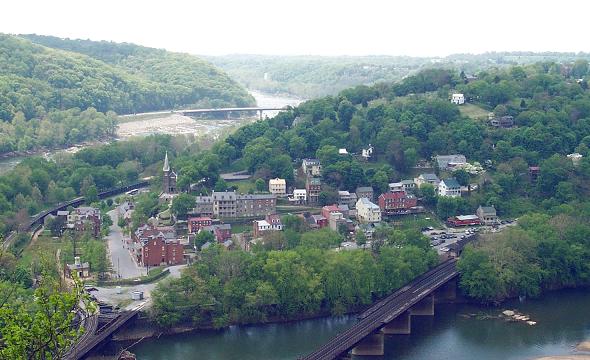
The Potomac's source is a small spring at the Fairfax Stone in West Virginia. From there, the river gathers many tributaries, winding through the mountains and valleys of Appalachia. One of its most dramatic turns occurs at Harper's Ferry where the Shenandoah meets the Potomac.

Harpers Ferry

At Great Falls, the Potomac tumbles down from the Appalachian Highlands to the sandy soils of the Atlantic Coastal Plain.  Visitors from the colonial era to the modern era relish the views here. Today visitors at Great Falls will not only marvel at the cataracts, but also the engineering efforts of those who sought to fulfill George Washington's dream of connecting the Chesapeake Bay to the Ohio River. The C & O Canal was only operational for a few short years, but remnants of the system are still functional at Great Falls Park.

Great Falls

Finally, the river flows almost 400 miles widening to over 11 miles as it reaches the Chesapeake Bay on the long, low, and barren peninsula named Point Lookout, Maryland.  Before the US Civil War, Point Lookout was home to a few hotels and boarding houses, but during the war it was converted into one of the largest and worst of the Union prisoner-of-war camps.

Point Lookout Postcard

Fishers, anglers, boaters, sailors and kayakers all enjoy the Potomac.

The Potomac River has a watershed of 14,670 square miles including tributaries in Maryland (the Monocacy, Savage, and St. Mary's Rivers); in Virginia (the Shenandoah and Occoquan Rivers); in West Virginia (the South Branch and Cacapon Rivers); in Pennsylvania (Conococheague and Antietam Creeks); and in Washington DC (the Anacostia River). The Potomac cradles forests, battlefields, farmlands, mountains, parks, and cities. It is known to many as our Nation's River.Potomac at Arlington

If you're searching for a home or condo in Northern Virginia with a view of the Potomac, contact Will Nesbitt with Condo Alexandria.

Wessynton: Contemporary homes in a historical setting

Nine miles south of Old Town is Wessynton, a Mount Vernon community filled with history and contemporary homes. Being located near the Mount Vernon Estate and George Washington’s Grist Mill, it seems only natural that this site would be home to plenty of history. However, this area is particularly heavy with American history and tradition.
George Washington’s Gristmill and Distillery
At one point, Quakers lived on the Wessynton site, which was originally settled by Native Americans. Eventually, George Washington’s half-brother, Lawrence, inherited the land where George Washington built the Mansion House. A South Carolinian restored the Mansion House, at the time in disrepair, shortly before the Civil War. Homes that stand in the area today were built mostly in the 1960s and they tend to have a more contemporary style than other homes in the Mount Vernon area. Architectural features include odd sizes, tall windows and a lack of ornamentation. Wessynton homes tend to enjoy partially or fully furnished basements along with garages and plenty of windows to let in natural light. Plus, community amenities include a boat ramp, common grounds, an outdoor pool, tennis courts, tot lots and playgrounds, making this community a great place for families with children.

The Marshall House

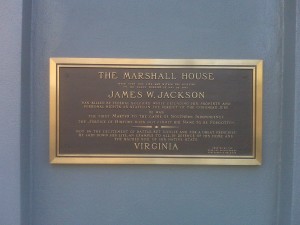
Plaques are found on many buildings and homes in Old Town Alexandria. "Plaqued" homes are not uncommon in Old Town Alexandria and a historical plaque is generally considered to enhance the value of the property.  The plaque for the Marshall House is found on King Street on the Hotel Monaco. It reads:
historical placque
History is around every corner of Northern Virginia

The Marshall House stood upon this site and within the building on early morning of May 24, 1861 James W. Jackson was killed by Federal soldiers while defending his property and personal rights, as stated in the verdict of the coroners jury. He was the first martyr to the cause of Southern Independence. The Justice of History does not permit his name to be forgotten. Not in the excitement of battle, but coolly and for a great principle, he laid down his life, as an example to all, in defence of his home and the sacred soil of his native state, Virginia.

Erected by the Sons and Daughters of Confederate Soldiers

$38 Million Gift From Reynolds Foundation to Support New George Washington Library

  Mount Vernon, Virginia -- The Donald W. Reynolds Foundation has pledged $38 million to Mount Vernon, the home of George Washington, to construct a new library destined to be the international headquarters for knowledge about America’s most famous founding father. Construction of the 45,000 square foot facility, which will be named the Fred W. Smith National Library for the Study of George Washington, is expected to begin in early 2011, with a completion date in 2012.  The facility will be tucked into the woods across from Mount Vernon’s conservation complex and within walking distance of the Mansion itself. As the nation’s first and only center for amassing and disseminating knowledge about Washington, the Fred W. Smith National Library for the Study of George Washington will safeguard Washington’s books and manuscripts, serve as a scholarly retreat, create educational outreach programs on Washington, and provide seminars and training programs with a special focus on Washington’s leadership. As the longtime chairman of the Donald W. Reynolds Foundation, Fred W. Smith has championed a number of projects related to George Washington, including the purchase of the famous Lansdowne portrait of Washington by Gilbert Stuart for the Smithsonian’s National Portrait Gallery.  In addition, under Smith’s leadership, the Foundation has supported the construction of a museum and education center at Mount Vernon, a pair of major traveling exhibitions about Washington, and special programs focusing on Washington for students and teachers across the nation. “I am pleased and humbled that my fellow trustees have approved the award of this grant and the naming opportunity in my honor,” stated Smith.  “It is our hope that this new facility will be a tool that the staff at Mount Vernon and Washington scholars can use to keep his place in American History as not only the Father of our Country but arguably our greatest president of all time.” The Foundation’s gift is the largest in the history of Mount Vernon, which ranks as the oldest and most visited national preservation project in America.  The Mount Vernon Ladies’ Association, which purchased the estate from the Washington family in 1858 and opened it to the public in 1860, is unusual in that it receives no funds from the local, state, or federal governments. “Fred Smith and the Donald W. Reynolds Foundation have enabled us to remain a leader among historic sites around the globe, without calling upon the government for help,” noted Boyce Ansley, Regent of the Mount Vernon Ladies’ Association.  “Mount Vernon is a totally different and far more exciting educational experience because of their support.” The idea for a facility that serves the role of George Washington’s presidential library is not a new one—it has been part of Mount Vernon’s master plan for several years.  Although Washington continues to be one of the most familiar faces in American history, numerous surveys and focus groups have revealed that a majority of Americans—particularly those in younger generations—know little about Washington’s achievements or personality.  Coverage of Washington in many history textbooks has declined to about 10 percent of what it was 50 years ago.  When one state’s high school students were recently asked the question, who was America’s first president, only 26 percent identified “George Washington” as the right answer. Most American history scholars generally rank Washington as one of the nation’s three most important presidents, along with Abraham Lincoln and Franklin D. Roosevelt.  “Few scholars would argue that Washington’s leadership and character still sets the gold standard,” noted James Rees, President of George Washington’s Mount Vernon.  “He remains a very relevant role model, particularly as the nation faces a challenging time in its history.” Although The Fred W. Smith National Library for the Study of George Washington will house hundreds of manuscripts, books and other documents drafted and owned by Washington, the complete array of Washington’s written works, which number in the tens of thousands, are spread among collectors, both public and private, across America.  But Mount Vernon’s library will bring them all together in a complete digital record of letters to and from Washington, assembled by scholars at the University of Virginia over a period of some 40 years.  All the records related to The Papers of George Washington project will be transferred to the library at Mount Vernon when the last of approximately 90 volumes of letters is edited, roughly 15 years from now. Until then, the library will provide a secure and environmentally friendly home to 45 books from Washington’s original library, as well as 450 letters and other manuscripts written in his hand.  The collection also includes approximately 1500 additional 18th-century books, as well as thousands of important 19th-century newspapers, manuscripts, and documents.  The bulk of the library stacks will be filled with modern books about Washington and the founding era, which will be made available to a much wider constituency. Historians and authors will have a far easier time accessing the information in Washington’s writings, and Mount Vernon will more than double its library staff to provide expertise and assistance.  Serious researchers who are drafting articles, papers or books about Washington will be lodged in a convenient guest house adjacent to the Library, equipped with six bedrooms. Simultaneously, the Mount Vernon Ladies’ Association hopes to create a Mount Vernon Press, which will publish new research on Washington, his family and his times, in both printed and digital versions. A team of education and media experts will also move to the new Library, charged with the task of disseminating the research findings to the largest and most diverse audiences.  To accomplish this goal, the Association will form partnerships with universities, state school systems, patriotic societies, technology firms, movie producers, computer game creators, and others from both the public and private sectors. The Library will also host small and medium-sized conferences and symposiums focusing primarily on leadership training.  Five meeting spaces will accommodate between 15 and 100 guests, working in tandem with two larger spaces across the street at the Mount Vernon Inn Complex—a Distance Learning Classroom that accommodates 40 participants in a high-tech environment and the Robert H. and Clarice Smith Auditorium with a capacity of 200 guests. Over a period of three years, the Association is spending nearly $2 million to expand and improve its website technology, and thousands of period artifacts, books, and manuscripts will be included on the site. The Association has also announced that it has entered the first phase of an $80 million capital campaign, with the commitment from the Donald W. Reynolds Foundation providing almost half the goal.  In addition to building the Library and adjacent guest house, funds from the campaign will endow the Library’s operation, underwrite new positions, and create new programs, especially for students and teachers. “We are pleased to be the lead donor in the Capital Campaign to build and endow the Fred W. Smith National Library for the Study of George Washington,” stated Steven Anderson, President of the Donald W. Reynolds Foundation.  “We believe that this facility will enhance educational outreach from Mount Vernon in much the same way that the Donald W. Reynolds Museum and Education Center expanded the onsite experience for visitors to the historic estate.” The Donald W. Reynolds Foundation is a national philanthropic organization founded in 1954 by the late media entrepreneur for whom it is named.  Headquartered in Las Vegas, Nevada, it has committed over $69 million in support of Mount Vernon. Press Release from MountVernon.org