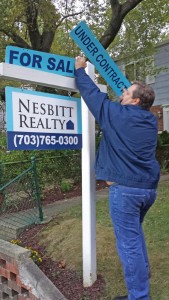
Homeowners from Alexandria have changed houses less in the past years. During the first quarter of 2019, homeowners in Alexandria have sold their homes have lived in it for an average of 8.05 years. As compared to an average of 8.17 years during the last quarter of 2018, the numbers has started to decline.
Continue reading
Grist Mill Woods is in Alexandria 223091. Decide what you can afford. Generally, you can afford a home equal in value to between two and three times your gross income.
2. Develop your home wish list. Then, prioritize the features on your list.
3. Select where you want to live. Compile a list of three or four neighborhoods you'd like to live in, taking into account items such as schools, recreational facilities, area expansion plans, and safety.
4. Start saving.Do you have enough money saved to qualify for a mortgage and cover your down payment? Ideally, you should have 20 percent of the purchase price saved as a down payment. Also, don't forget to factor in closing costs. Closing costs --- including taxes, attorney's fee, and transfer fees --- average between 2 and 7 percent of the home price.
5. Get your credit in order.Obtain a copy of your credit report to make sure it is accurate and to correct any errors immediately. A credit report provides a history of your credit, bad debts, and any late payments.
6. Determine your mortgage qualifications.How large of mortgage do you qualify for? Also, explore different loan options --- such as 30-year or 15-year fixed mortgages or ARMs --- and decide what's best for you.
Odyssey is in Arlington 222017. Get preapproved. Organize all the documentation a lender will need to preapprove you for a loan. You might need W-2 forms, copies of at least one pay stub, account numbers, and copies of two to four months of bank or credit union statements.
8. Weigh other sources of help with a down payment. Do you qualify for any special mortgage or down payment assistance programs? Check with your state and local government on down payment assistance programs for first-time buyers. Or, if you have an IRA account, you can use the money you've saved to buy your fist home without paying a penalty for early withdrawal.
9. Calculate the costs of home ownership. This should include property taxes, insurance, maintenance and utilities, and association fees, if applicable.
10. Contact a REALTOR®. Find an experienced REALTOR® who can help guide you through the process.
For more information or to set up an appointment call Julie at (703)765-0300.
Although there are numerous benefits to owning a condo which include the lifestyle that such ownership entails; individuals living as single, young professionals who are just starting out, are arguably the most notable beneficiaries. The economic benefits that condo ownership provides for this particular demographic are two-fold. First, owning a condo is certainly less expensive than owning residential property insofar as the material upkeep and residual costs that homeownership necessitates. Second, most contemporary condo buildings offer a host of wide-ranging amenities that would command a considerable cost to an individual homeowner but which can be enjoyed instead at a significantly reduced rate to condo-owners who share jointly in the overall expense.
These otherwise high-priced features and amenities usually include guarded and/or private, enclosed parking; 24-hour security and front desk staff; indoor and outdoor swimming pools; clubhouses; gated recreational facilities; etc., etc. (the list goes on and on!!). To that extent, condo ownership is therefore an ideal middle ground for the single, young professional who may very well aspire towards homeownership someday but who still remains a far cry away from white picket fences, two-car garages and 2.5 children.
The condos of Cameron Station include Carlton Place, Condominiums of Cameron Station Blvd, Main Street, Oakland Hall, Residences at Cameron Station and Woodland Hall.
In addition to the economically sound benefits that condo ownership provides, there are other elemental and lifestyle benefits that are associated with condominium ownership as well. Today, there are as many types of condominiums out there as there are types of people. Plainly put, the condominium marketplace has progressed with such rapidity that the variety and availability of choice in condo options is as original and unique as individual homes. Thus, each type can satisfy the different needs of different individuals and therefore enhance and accommodate every kind of lifestyle. For example, there are distinctions between what are popularly thought of as 'condominium apartments' versus those that are known as 'condominium townhouses', which might have small differences from one another save for their structure regulations. There are also condominiums known as freeholds whereby a condo owner owns the plot of land as well as any structure on the land such as a house or townhouse.
Finally, for single or young professionals who are still growing into their grownup-ness, condo ownership signifies an increase in responsibility and a commitment to ownership. To be clear, condo living isn't like renting a single dwelling home or apartment and this is due to the dual nature that comes with owning any condo unit. Condominium owners hold ownership over their respective units but, additionally, each owner is also responsible for the operating costs and maintenance of the all of the shared elements on the property such as lobbies, passageways, and elevators. Here, owning a condo is effectively choosing to live within a community of other condo unit owners and thus, your neighbors. Each condominium complex is a unique community and each owner accepts the rules and regulations that are equally unique to condo living.
Arlington
In a condominium complex, you also become part of a distinctive community where you as an individual become an integral part in the community as a whole; and this includes being an essential part of the decision making process. However, the advantages that come with shared communal facilities like the pool, clubhouse, and state-of-the-art gym are collectively a strong incentive to watch your neighbors' back.
In summation, owning a condo can provide both economically sensible and personally enjoyable benefits to any owner looking to buy but especially for individuals who are single, working and fairly young professionals who are new to the game but ready for more. In addition, because of the multiplicity and vast assortment of condominium units and styles that are available, condo ownership includes something for everyone. Lastly, although buying a condo certainly signifies a new level of maturation and grownup responsibility; the advantages to living in a shared community and to be able to engage as an honest and responsible neighbor will hopefully serve you both by keeping your pocketbook and your sense of self a little more full.
Condominiums are found in all shapes, sizes, prices and types. Are you looking for a high-rise condo, a mid-rise or a garden-style condo? Maybe you'd prefer a townhouse?
The term "garden-style" condo usually refers to a condominium residence in a building that has less than three stories. Most garden-style condos have balconies or patios for each residence. Many garden-style condos have a main entrance that opens to a common-area hallway. Additional common areas include the green space and "gardens" surrounding the structures. If you're interested in garden-style condos you'll have a lot of options in Northern Virginia.
From the suburban feel of Kingstowne to the central location of Bolling Brook from the vintage charm of Belle View to the chic feel of Carlyle Square, are just some of the many Northern Virginia condominium communities we feature.
Mid-rise condos are taller than garden-style condos, but smaller than high-rise condos. Mid-rise condos in Northern Virginia are 5 to 8 stories tall and are generally found close to or inside the Beltway.
High-rise condos have more than 9 floors. They are generally found inside the Beltway and are often located near Metro stations, public transportation, or major commuter traffic arteries like I-395.
Of course as a homeowner you'll now be responsible for maintenance and repairs on the house. You'll be a part of the neighborhood watch and the garden club. According to most studies, you're more likely to vote, and to participate in local government activities. You're now one of the landed gentry. According to the Rossi and Weber National Survey of Families, home owners possess significantly higher levels of self-confidence than renters.
Tax advantages are one of the biggest financial benefits of home ownership. The typical home owner that pays a $1,000 house payment will realize tax savings of about $120 each month. (As a general rule, most homeowners can deduct most or all of their interest payments on their home loan, property taxes and loan points, but check with your tax advisor about your situation.)
This increase confidence and wealth will have an impact on your family life as well. According to Boehm & Schlottmann, University of Tennessee, "Children of home owners are 59% more likely to become homeowners. Their children are also 25% more likely to graduate from high school and 116% more likely to graduate from college."
As an owner, you'll stop paying rent and you'll start building ownership equity. A survey of consumer finance by the Federal Reserve Board found that the median net worth of most modest-income owners is almost $60,000 compared to less than $10,000 for renters in the same income group.
In many cases, your home will provide you with more privacy than rental living. For some, this means a quieter living environment, for others it's the ability to have a grow garden, have a backyard barbecue or a build a garage. You'll have the freedom to make whatever changes or improvements you like. Now that you control your living environment, you can make adjustments as your family changes or just as your personal taste dictates.
In the end, the goal is happiness, not to have the most marbles.
For more information or to set up an appointment call Julie at (703)765-0300.
Home warranties can be attractive to home owners or buyers who are looking at purchasing a property. These service contracts can cover all of a home’s major systems, such as the furnace or air conditioner, and will cover needed repairs if the appliance breaks or damaged.
Some sellers are offering a home warranty to try to lure buyers.
But not all home warranties are the same. Experts say you should carefully weigh costs, policy allowances, and customer feedback before making a decision so that you ensure you’re getting the best deal. Home warranties cost about $250 to $500 a year.
Here are some more tips from experts in shopping for a home warranty:
Find customer reviews. Web sites, such as homewarrantyreviews.com, provide reviews of home warranty companies. You also might check how each company is rated with your local Better Business Bureau.
typical home in Belle Haven Estates
Check for extra fees. Will you have to pay a fee for service calls?
Check the coverage allowance. Are there any exclusions to coverage? Will the allowance cover the entire cost of a broken appliance or just some of it? For example, if you have older appliances and mechanicals, will the policy cover the full cost of replacing it or just the depreciated value? If the policy only covers the depreciated value when a 20-year-old furnace dies, for example, the reimbursement may not be enough to buy a new one. Also, verify what appliances are all included in the coverage. Some companies will allow you to add coverage for swimming pools, while others won’t.
"The biggest thing is awareness of what the exclusions are," Greg McBride, a senior financial analyst at Bankrate.com, told the Chicago Tribune. "The mere presence of a warranty, by nature, tends to have exclusions. Being aware of that can aid in the decision-making process."
Source: “When Home Warranties Are Worth It,” Chicago Tribune (Feb. 8, 2011)
The percentage of U.S. households that owned their homes remained at 66.9 percent in the third quarter, unchanged from the second quarter, the Census Bureau said Tuesday.
The homeownership rate held steady for decades at 64 percent, but climbed to 69 percent in 2004. Since the housing bubble burst in 2006, it has declined steadily.
Because of rising foreclosures and tightening lending standards, homeownership is likely to decline to 66.7 percent, the rate in 1999, predicted IHS Global Insight economist Patrick Newport.
Source: The Associated Press, Alan Zibel (11/02/2010)
Home Prices In Arlington Continue To Hike
The housing market in Arlington County is getting more and more expensive as potential buyers continue to have fewer homes and condos to choose from.
Inlet Cove is alongside Route 1 This neighborhood of townhouses is near grocers and eateries Inlet Cove is close to Fort Belvoir, Alexandria, and Potomac Mills shops, in the city of Woodbridge Interior to these properties are multilevel Inlet Cove is serene
Pending home sales increased again in March, affirming that a surge of home sales is unfolding for the spring home buying season, according to the National Association of REALTORS®. The Pending Home Sales Index, a forward-looking indicator based on contracts signed in March, rose 5.3 percent to 102.9 from 97.7 in February, and is 21.1…
Some of the best housing deals are on high-end homes, many over $1 million. Some of them need TLC or they aren’t in the most-coveted locations. But there are plenty of desirable properties and lots of sellers who are getting impatient. Buyers with cash have the best opportunities. Buyers who need a mortgage should move…
The National Association of Realtors recently did a study about the characteristics of home buyers. Some of the findings might surprise you. Thirteen percent of buyers purchased a home with one or more parents and grandparents together with adult children. There were several reasons given for purchasing a multi-generational home. Cost savings; Children over the…

 Homeowners from Alexandria have changed houses less in the past years. During the first quarter of 2019, homeowners in Alexandria have sold their homes have lived in it for an average of 8.05 years. As compared to an average of 8.17 years during the last quarter of 2018, the numbers has started to decline.
Continue reading
Homeowners from Alexandria have changed houses less in the past years. During the first quarter of 2019, homeowners in Alexandria have sold their homes have lived in it for an average of 8.05 years. As compared to an average of 8.17 years during the last quarter of 2018, the numbers has started to decline.
Continue reading

 Although there are numerous benefits to